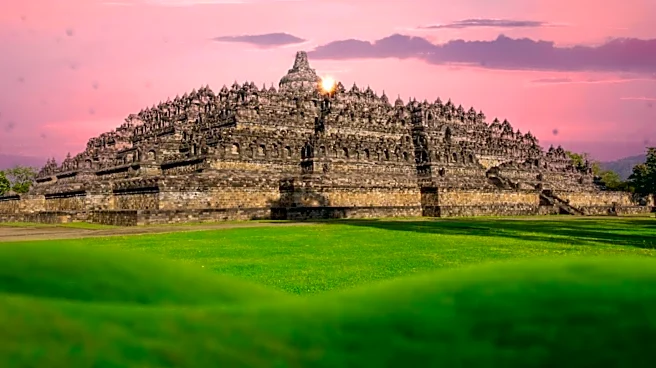








Borobudur is not merely an isolated architectural marvel; it is deeply integrated into its natural and spiritual landscape. Located in Central Java, Indonesia, the temple's position is strategically chosen, nestled in an elevated area between towering volcanoes and significant rivers. This geographical placement, combined with its intricate design, reflects a profound understanding of Buddhist cosmology and suggests a ritualistic connection with other
nearby temples. The surrounding Kedu Plain, often called "the garden of Java" due to its fertility, further enhances the sacred aura of this ancient site.
A Landscape of Spiritual Significance
Borobudur is situated approximately 25 miles northwest of Yogyakarta and 53 miles west of Surakarta. Its location is striking: an elevated area flanked by twin volcanoes, Sundoro-Sumbing and Merbabu-Merapi, and bordered by two rivers, the Progo and the Elo. This region, known as the Kedu Plain, is considered a Javanese "sacred" place, renowned for its high agricultural fertility. The presence of active volcanoes, such as Merapi, which has been active since the Pleistocene era, has shaped the surrounding landscape, including the area around Borobudur.
This unique geographical setting has led to much speculation, particularly regarding the existence of a surrounding lake. In 1931, Dutch painter W.O.J. Nieuwenkamp proposed that Borobudur represented a lotus flower floating on a lake in the Kedu Plain. This theory gained traction, with some claiming in 2004 that the temple was built above the floor of a dried-out paleolake. Lotus flowers are prevalent in Buddhist art, often serving as thrones for Buddha or bases for stupas, and the general architecture of Borobudur, particularly its three circular upper platforms, has been interpreted as representing a lotus leaf. While initial studies in the 1970s and 1980s found no pollen or spores indicative of a water environment, later geological studies, examining stratigraphy, sediments, and pollen samples, have supported the existence of a paleolake near Borobudur, suggesting the temple was indeed on its shores during the 13th and 14th centuries, with the lake's extent fluctuating over time.
Ritual Alignment with Neighboring Temples
During the early 20th-century restoration efforts, Theodoor van Erp discovered a significant alignment: three Buddhist temples in the region—Borobudur, Pawon, and Mendut—are positioned along a straight line. This precise alignment strongly suggests a ritual relationship between the three temples, even though the exact nature of the ritual process remains unknown. The architectural styles and ornamentation of these three temples are consistent with the same period, further reinforcing the idea of a shared purpose or interconnected spiritual practice.
This discovery lends credence to local legends that spoke of a paved road, flanked by walls, that once connected the three temples. The existence of such a ritual path would have facilitated a pilgrimage route, guiding devotees through a series of sacred sites. The design of Borobudur itself, with its extensive system of stairways and corridors and 1,460 narrative relief panels, is intended to guide pilgrims through a spiritual journey. The monument's vertical structure, divided into a base, body, and summit, metaphorically represents the three stages of mental preparation for enlightenment in Buddhist cosmology: Kamadhātu (the world of desires), Rupadhatu (the world of forms), and Arupadhatu (the formless world). This cosmological journey, potentially integrated with the ritual path connecting Borobudur, Pawon, and Mendut, highlights the profound spiritual planning embedded within the sacred landscape of Central Java.