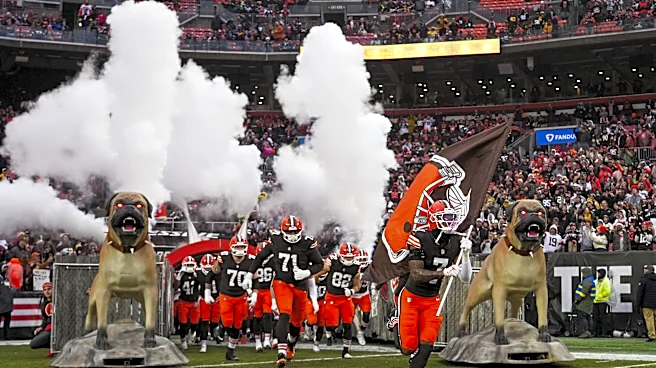





The decision to move the Cleveland Browns from their long-time home to Baltimore for the 1996 NFL season was a bombshell that ignited widespread controversy. Owner Art Modell's announcement, made on November 6, 1995, came after years of financial struggles and secret negotiations, leaving fans and the city of Cleveland reeling. The unfolding events revealed a complex interplay of financial desperation, political maneuvering, and deeply emotional reactions
from a loyal fanbase.
The Road to Relocation: Secret Negotiations and Public Statements
Art Modell's financial difficulties with the Cleveland Browns were a long-standing issue, leading him to consider drastic measures. As early as December 12, 1994, Modell expressed to his board of directors his skepticism about a proposed referendum to raise income tax for stadium improvements. He warned that if such a referendum failed, he would be forced to move the team. This statement set a precedent for the eventual relocation, signaling his growing frustration with the situation in Cleveland.
Despite the Browns' on-field success in 1994, finishing 11-5 and making the playoffs, and optimistic predictions for the 1995 season, Modell's financial woes persisted. During the 1995 season, as the team's performance became inconsistent, minority owner Al Lerner began privately advocating for a move to Baltimore. Lerner successfully persuaded Modell to initiate contact with John Moag, the chairman of the Maryland Stadium Authority. Baltimore had been actively seeking an NFL team, and the league had indicated that the city would be a candidate for a new or relocated franchise if a stadium was already in place. Maryland officials, however, were cautious, having previously experienced the departure of the Colts, and were unwilling to commit funds without a firm team agreement. After initial unreturned calls, Modell eventually allowed Lerner to meet with Moag in late July 1995, albeit with the stipulation that Lerner convey Modell's lack of serious intent to move. During this meeting, Moag presented an offer for a new $220 million stadium, opening the door for further discussions should the team's owners become genuinely interested. These negotiations continued in secret, intensifying until September when Moag pressed for immediate action. Shortly thereafter, Modell, Lerner, and Moag met in Lerner's Manhattan office, where Modell, after some hesitation and assurances from Moag, signed a memorandum of understanding for the move.
The Public Announcement and Immediate Fallout
On November 6, 1995, with the Browns holding a 4-5 record, Art Modell officially announced at a press conference in Camden Yards that he had signed a contract to move the Cleveland Browns to Baltimore for the 1996 season. The team was slated to play at Memorial Stadium, the former home of the Colts, until a new stadium could be constructed. Modell justified his decision by stating his belief that the city of Cleveland lacked both the funding and the political will to build a first-class stadium. This announcement sent shockwaves through Cleveland and the NFL.
Just one day after Modell's announcement, on November 7, 1995, Cleveland voters overwhelmingly approved the very tax issue that Modell had cited as a concern—a referendum for the reconstruction of Cleveland Stadium. Despite this clear demonstration of public support for stadium improvements, Modell remained resolute. He publicly dismissed any possibility of reversing his decision, declaring that his relationship with Cleveland was irrevocably severed. He famously stated, "The bridge is down, burned, disappeared. There's not even a canoe there for me." This firm stance underscored the finality of his decision, despite the city's immediate efforts to address his stated concerns. Modell later confided that signing the memorandum in September had been one of the hardest things he had ever done, marking the end of his life in Cleveland, a sentiment echoed by his long-time general counsel, Jim Bailey, who noted Modell was "emotionally crushed" during the signing.
Legal Battles and Fan Outcry
The city of Cleveland swiftly responded to Modell's announcement by filing a lawsuit against Modell's company, the Browns, Stadium Corp., the Maryland Stadium Authority, and its director, John A. Moag Jr. The lawsuit, *City of Cleveland v. Cleveland Browns et al.*, alleged a breach of the lease agreement, which stipulated that the team was to play its home games at Cleveland Stadium for several years beyond 1995 and remain in the city until at least 1998. This legal action was just one of many, as fans and season ticket holders also filed multiple lawsuits. The controversy even reached the U.S. Congress, which held hearings on the matter.
The fan reaction in Cleveland was one of intense anger and betrayal. Comedian Drew Carey, a Cleveland native, returned to his hometown on November 26, 1995, to host a "Fan Jam" protest against the proposed move. During a Browns game against the Pittsburgh Steelers in Pittsburgh, a protest was staged, though ABC, which was broadcasting the game and Carey's new sitcom, refused to cover or mention it. This particular game was notable as one of the rare instances where Steelers and Browns fans united, with Pittsburgh fans feeling Modell was robbing them of a long-standing rivalry. Browns fans expressed their fury by wearing hats and shirts emblazoned with "Muck Fodell." Team sponsors largely withdrew their support, leaving Cleveland Stadium devoid of advertising in the team's final weeks. The team's performance suffered, finishing the season 5-11. After the announcement, the Browns lost all their remaining home games except for the final one, a 26-10 victory over the Cincinnati Bengals. The game itself was not televised locally, but NBC provided extensive pre-game coverage from Cleveland, during which host Bob Costas noted the "final sad irony" of Brooklyn native Modell moving a beloved franchise, much like Walter O'Malley had moved the Dodgers to Los Angeles.