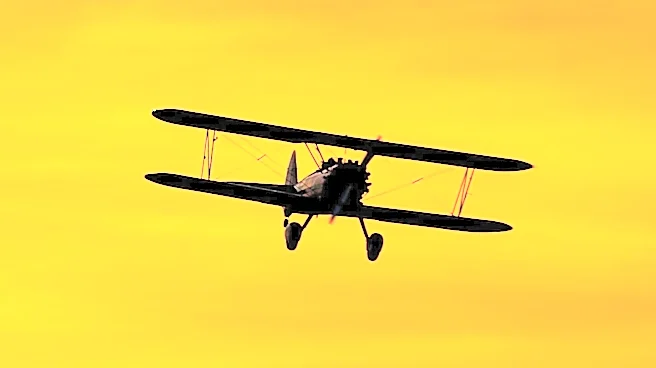









The Wright brothers, Orville and Wilbur, achieved their first successful powered flights in 1903, marking a pivotal moment in aviation history. However, these initial groundbreaking achievements were not immediately met with widespread public recognition or belief. For several years, their work remained largely out of the public eye, shrouded in a degree of secrecy driven by practical concerns and legal advice. It wasn't until 1908 that the brothers truly
unveiled their flying machines to the world through public demonstrations, transforming skepticism into astonishment and securing their place as pioneers of flight.
Early Flights and the Veil of Secrecy
On December 17, 1903, near Kitty Hawk, North Carolina, the Wright brothers made four brief flights, with the longest covering 852 feet in 59 seconds. These were significant achievements, demonstrating sustained, controlled, powered heavier-than-air flight. Despite this success, the flights were not widely publicized. While U.S. newspapers largely accepted their claim, initial reports were often inaccurate. In January 1904, the brothers issued a statement to newspapers to accurately describe their flights.
Following an announced public demonstration in May 1904 in Dayton, the Wrights made a conscious decision to limit further publicity. Their patent attorney advised them to keep the details of their machine confidential, a strategy aimed at protecting their intellectual property. This period of relative quiet meant that while a few dozen people witnessed flights by the Wright Flyer III in 1905, the broader public remained largely unaware or unconvinced of the true extent of their accomplishments. Even as late as 1906, almost three years after their first flights, the U.S. Army rejected an approach from the Wrights, citing that the machine's ability to fly had not been sufficiently demonstrated.
Growing Skepticism and the Need for Public Proof
During the years following their initial successes, the lack of widespread public demonstrations led to considerable skepticism, particularly in Europe. The French media, for instance, continued to refer to the Wright brothers as "bluffeurs" even five years after their original success. This disbelief was fueled by the absence of verifiable public flights and the brothers' cautious approach to sharing details of their invention. While pioneers like Octave Chanute and British Army officer Lt. Col. John Capper believed the Wrights' statements, their belief was not universal.
This period of doubt highlighted a critical challenge for the Wrights: transforming their private achievements into publicly accepted facts. The world needed to see the machines fly with their own eyes. The brothers were in a unique position, having achieved what many others were still striving for, yet they faced the hurdle of convincing a skeptical world that their claims were legitimate and not merely exaggerated reports or hoaxes.
The Pivotal Year of 1908: Public Demonstrations Begin
The year 1908 marked a dramatic shift in the Wright brothers' strategy and public perception. By this time, their claims were gaining enough traction that they were in negotiations with governments in Britain, France, and Germany, as well as their own. Early in 1908, they secured contracts with both the U.S. War Department and a French syndicate. These contracts necessitated public acceptance trials, which would finally bring their flying machines into the global spotlight.
In May 1908, Wilbur Wright sailed for Europe to conduct acceptance trials for the French contract. His flights there were nothing short of astonishing. Simultaneously, Orville Wright conducted demonstrations in the United States. These public showings were crucial. They provided undeniable proof of the Wright Flyer's capabilities, silencing critics and captivating audiences. The flights were widely reported, and the sheer spectacle of controlled, sustained flight amazed the world. This period of public demonstration effectively solidified the Wright brothers' prestige and led to almost universal public recognition of their early claims as legitimate, fundamentally changing the course of aviation history and public understanding of what was possible.