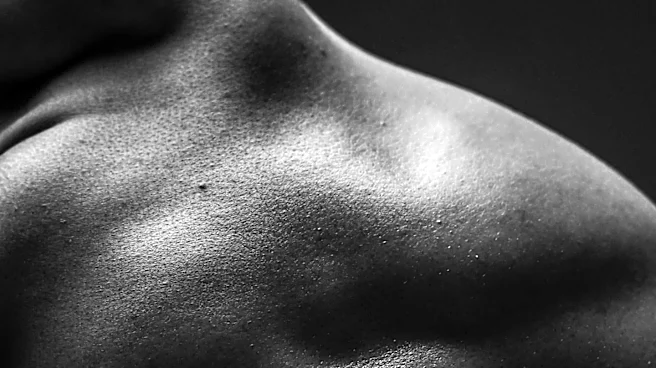
The human shoulder is a remarkable feat of biological engineering, designed to provide an extensive range of motion for the arm and hand while also maintaining enough stability for demanding tasks like lifting and pushing. This complex region of the body is not just a single joint but a collection of structures working in concert, involving three bones, multiple joints, and an intricate network of supporting tissues. Understanding its fundamental
components reveals why the shoulder is both incredibly versatile and susceptible to injury.
The Bony Framework of the Shoulder
The foundation of the shoulder is built upon three primary bones: the clavicle, commonly known as the collarbone; the scapula, or shoulder blade; and the humerus, which is the upper arm bone. These bones articulate in specific ways to create the shoulder's overall structure. The scapula is particularly crucial, as it provides several key features, including the glenoid cavity, the acromion, and the coracoid processes. The glenoid cavity is a dish-shaped portion of the lateral scapula that serves as the "socket" for the main shoulder joint. The clavicle connects the shoulder to the rest of the axial skeleton, while the humerus forms the "ball" of the primary joint.
The Glenohumeral Joint: The Core of Shoulder Movement
At the heart of the shoulder's mobility is the glenohumeral joint, often simply referred to as the shoulder joint. This is a classic ball-and-socket joint, formed by the articulation between the rounded head of the humerus and the shallow glenoid cavity of the scapula. This design allows the arm to rotate in a circular fashion and to hinge out and up away from the body, providing tremendous mobility. However, this extensive range of motion comes at a cost: the glenohumeral joint is one of the most easily dislocated joints in the body due due to the shallowness of its socket and the relatively loose connections that allow such freedom of movement. There is an approximate 4-to-1 disproportion in size between the large head of the humerus and the smaller glenoid cavity, further contributing to its mobility and potential instability.
Supporting Structures and Other Joints
Beyond the glenohumeral joint, the shoulder complex includes other important articulations and a wealth of supporting structures. The acromioclavicular joint, located between the acromion of the scapula and the clavicle, and the sternoclavicular joint also contribute to overall shoulder movements. Holding these bones in place and facilitating smooth motion are ligaments, muscles, and tendons. Ligaments connect bones to each other, providing stability, while tendons attach muscles to bones, enabling movement. The rotator cuff, a group of muscles and their tendons, directly surrounds and attaches to the shoulder joint, playing a vital role in both stability and movement. Additionally, white hyaline cartilage, known as articular cartilage, covers the ends of the bones, allowing them to glide smoothly against each other. The joint space itself is enclosed by a synovial membrane, which produces fluid to lubricate the joint. Two filmy, sac-like structures called bursae are also present, permitting smooth gliding between bone, muscle, and tendon, and cushioning the rotator cuff from the bony arch of the acromion. Another type of cartilage, the glenoid labrum, is more fibrous and rigid than articular cartilage and is found only around the socket, where it is attached, further enhancing the joint's structure.