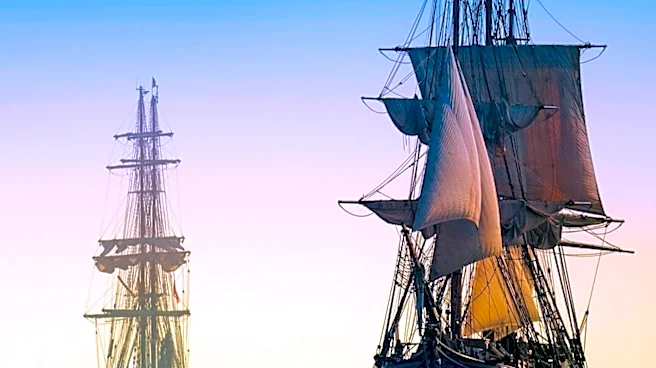







HMS Guerriere, a name etched into the annals of naval history, began its life not as a British vessel, but as a French frigate. Its journey from a French-built warship to a Royal Navy vessel, and ultimately to its destruction in a famous engagement with the USS Constitution, is a tale of capture, service, and a fateful encounter that challenged naval perceptions during the War of 1812. The ship's material state and its previous history played a significant
role in the narrative of its final battle.
Origins and British Service
The Guerriere was originally a 38-gun frigate of the French Navy, designed by Forfait. It was launched on September 15, 1799, and commissioned in May 1800. Its career under the French flag included a sortie in 1803 with the Duguay-Trouin, where they were forced to escape from a British ship, eventually reaching the safety of Corunna. In 1806, while sailing with other French ships to attack British and Russian whalers, the Guerriere was chased and brought to action by HMS Blanche. After a hard-fought battle, Blanche forced the Guerriere to surrender on July 19, 1806, and brought it back to Britain.
Upon its capture, the Guerriere was commissioned into the Royal Navy as HMS Guerriere. It underwent repairs and a refit, which increased its armament to 48 guns. The ship then served in the West Indies and off the American coast for several years, capturing a number of privateers. In 1808, under Captain Alexander Skene, it captured the French privateer brig Malvina and recaptured the British ship Juliana. Later that year, it surprised and captured the French privateer cutter Peraty, which was found to be the former HMS Barbara, previously captured by the French.
Pre-Battle Incidents and Deterioration
In 1809, Captain Robert Lloyd took command, followed by Captain Samuel John Pechell in 1810, who sailed the Guerriere to Halifax. A notable incident occurred on May 1, 1811, when the Guerriere stopped the brig USS Spitfire off New Jersey's Sandy Hook, impressing John Diggio, an apprentice sailing master and citizen of Maine. This event contributed to the tense atmosphere leading up to the War of 1812, especially after the USS President mistakenly engaged HMS Little Belt while attempting to recover Diggio. Pechell was replaced by Captain James Dacres in July 1811, and the Guerriere sailed for the Halifax Station, where it continued to detain American vessels, such as the brig New Orleans Packet.
By August 1812, the Guerriere was in a state of disrepair and was proceeding to Halifax for a much-needed refit. This deteriorated condition would become a key point in Captain Dacres' defense during his court-martial after the battle. He argued that the frigate, being French-built, was not as sturdy as British-built ships and was badly decayed. The fall of the mizzenmast, which significantly hampered the Guerriere early in its fight with the Constitution, was attributed as much to rot as to battle damage. This pre-existing weakness, combined with the Constitution's superior firepower, sealed the fate of HMS Guerriere on August 19, 1812, leading to its capture and subsequent fiery destruction at sea.