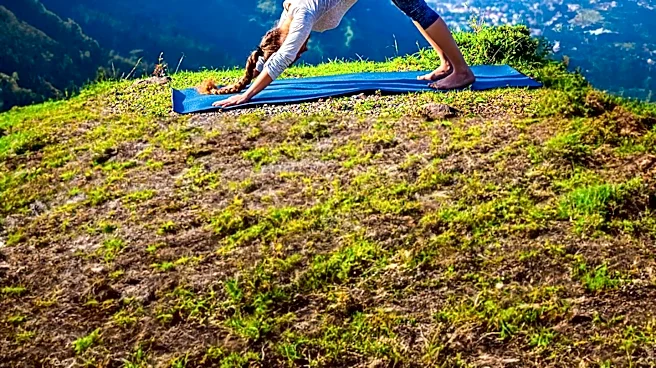




Downward Dog Pose, also known as Downward-facing Dog Pose or Downdog, is a widely recognized inversion asana in yoga as exercise. Its Sanskrit name is Adho Mukha Shvanasana. This pose is frequently practiced as part of flowing sequences, notably in Surya Namaskar, or the Salute to the Sun. While it doesn't have formally named variations, several playful adaptations are used to help beginning practitioners become comfortable with the posture. Downward Dog is known for its
ability to stretch the hamstring and calf muscles in the backs of the legs, while also building strength in the shoulders. Although some popular sites have cautioned against it during pregnancy, an experimental study involving pregnant women found it to be beneficial.
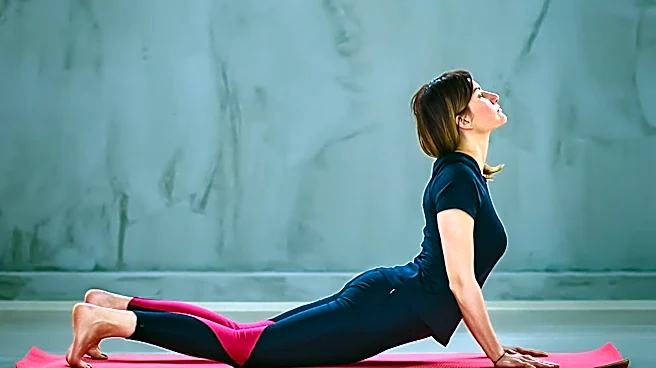
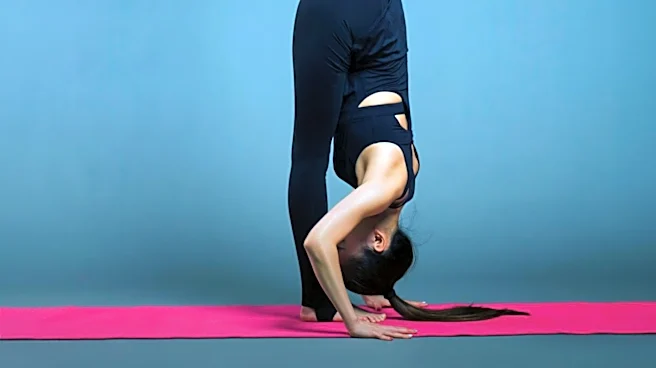
The physical description of Downward Dog involves having the head down, ideally touching the floor, with the body's weight distributed between the palms and the feet. The arms are stretched straight forward, positioned shoulder-width apart. The feet are typically about a foot apart, the legs are kept straight, and the hips are raised as high as possible. The approach to entering this pose can differ among various schools of yoga. For instance, in Iyengar Yoga, practitioners might enter the pose from a prone position, placing their hands beside the chest to set the distance between their hands and feet. In other schools, such as Sivananda Yoga, Downward Dog is integrated into the Surya Namaskar sequence, often following Urdhva Mukha Shvanasana (Upward Dog Pose) by exhaling, curling the toes under, and raising the hips. The Bihar School of Yoga refers to this pose as Parvatasana, or Mountain Pose, where the hands and feet are positioned somewhat closer to each other, resulting in a sharper angle at the hips. In this school, it is entered from a lunge, known as Ashwa Sanchalanasana, within a variant of Surya Namaskar.
Variations and Modifications for Practice
While Downward Dog can be a restorative pose for experienced practitioners, it can present a challenge for beginners. To make the pose more accessible, several variations exist. Practitioners can bend their knees, which allows the heels to lift slightly. Another modification involves supporting the heels, perhaps with a rolled-up yoga mat, to provide stability and comfort. The pose can also be varied by lowering one forearm to the floor while extending the other hand forward, or by combining these techniques. Other adaptations include bending one knee and lowering the hip on that side, or alternately "pedaling" by bending one knee and raising the ankle, then repeating on the other side, and even hooking each foot in turn behind the opposite ankle. Raising one leg, either stretching it straight out or bending the knee and flexing and extending the foot, is another common variation. Practitioners might also alternate between bending both knees and straightening the legs while bringing the shoulders forward directly above the hands. A twisting variation involves reaching back with one hand to grasp the opposite ankle.
Various props can also be utilized to assist in Downward Dog. For example, the pose can be supported with a strap anchored at waist-level on a wall, placed around the hips. A bolster can be used under the forehead for comfort, and a rolled blanket or towel can be placed under the feet if needed. For individuals with injuries, the pose can be modified by keeping the back horizontal and placing the hands on the back of a chair, which reduces pressure on the shoulders. These modifications highlight the adaptability of Downward Dog, allowing a wide range of practitioners to engage with the pose safely and effectively.
Downward Dog in Culture and Practice
Beyond its physical benefits and variations, Downward Dog has also found its way into broader cultural contexts. The pose has been playfully adapted in some instances, such as in "Doga," a form of yoga practiced by dog owners with their dogs. Doga was founded in America at the beginning of the 21st century and is characterized by the dog pose, though a Doga author and teacher, Mahny Djahanguiri, notes that despite appearances, dogs do not truly perform yoga. The pose's widespread recognition and its integration into various yoga styles underscore its significance as a fundamental asana. Its presence in sequences like Surya Namaskar emphasizes its role in dynamic yoga practices, while its adaptability through numerous variations ensures its accessibility to practitioners of all levels. The continuous exploration of Downward Dog, both in traditional yoga and modern adaptations, reflects its enduring appeal and versatility.