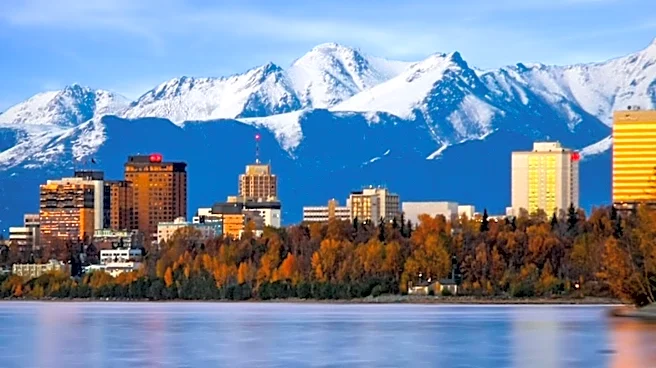






Chugach State Park, established on August 6, 1970, stands as a monumental achievement in Alaskan conservation and public land management. Signed into law by then-Governor Keith Miller, the park was conceived with a clear mandate: to offer extensive recreational opportunities, protect the breathtaking scenic values of the Chugach Mountains and other significant geographical features, and crucially, to safeguard the water supply for the city of Anchorage.
Managed by Alaska State Parks, it is not only a vital resource for local communities but also a significant natural landmark, ranking as the third-largest state park in the United States, surpassed only by California's Anza-Borrego Desert State Park and Alaska's own Wood-Tikchik State Park.
A Park of Disparate Landscapes and Diverse Offerings
Chugach State Park is characterized by its geographically disparate areas, each presenting unique attractions and facilities. While the majority of the park lies within the Municipality of Anchorage, a smaller northern section near Pioneer Peak, in the vicinity of Eklutna Lake, extends into the Matanuska-Susitna Borough. This varied topography contributes to the park's rich biodiversity and wide array of recreational pursuits. From dense forests at lower elevations to alpine tundras at higher altitudes, the park offers a microcosm of Alaska's diverse ecosystems, making it a prime destination for nature enthusiasts and adventurers alike.
Eklutna Lake: A Hub of Activity and Natural Beauty
Eklutna Lake is a prominent feature within Chugach State Park, serving as a focal point for numerous activities. The Lakeside Trail, stretching 12.7 miles (20.4 kilometers) along the lake's shores, leads to the mile-long Eklutna Glacier Trail, which quickly brings visitors to the moraines at the foot of the colossal blue ice of Eklutna Glacier. During summer, this trail is popular for hiking, mountain biking, ATV use, and horseback riding. For the more adventurous, a traverse maintained by the Mountaineering Club of Alaska begins at the trail's end, crossing the Eklutna, Whiteout, Eagle, and Raven glaciers over 31 miles (50 kilometers) to Crow Pass near Girdwood on the opposite side of the park.
In winter, the same routes transform into a playground for snowmobiling, snowshoeing, and cross-country skiing, depending on regulations and weather. The old roadbed nature of much of the trail makes it ideal for skijoring and dogsledding. The Eklutna Lake area provides two remote campgrounds and a frontcountry campground open in summer, along with two public use cabins available for rent on the Lakeside Trail. Non-motorized boats and those with electric motors are permitted on the lake. Towering over the lake is Bashful Peak, the park's tallest point, reaching 8,005 feet (2,440 meters). Bush planes can land on the unpaved Bold Airstrip on the far side of the lake, and the southern summit of Pioneer Peak is accessible via the Pioneer Ridge Trail from Knik River Road, outside park boundaries.
Flora and Fauna: A Rich Tapestry of Life
Visitors to Eklutna Lake can experience a remarkable variety of plant life across different elevations. Lower elevations are dominated by dense forests of white spruce, paper birch, and quaking aspen. The forest floor is a vibrant carpet of ferns, mushrooms, and wildflowers such as dwarf dogwood, fireweed, and the parasitic northern groundcone. As elevation increases, wildflowers like mountain avens and the alpine forget-me-not, Alaska's state flower, bloom profusely. Lower slopes feature alpine milkvetch, bog wintergreen, and wild geranium, while higher up, nootka lupine, coastal paintbrush, prickly saxifrage, and the poisonous yellow anemone give way to tundra mosses.
Late summer and early fall are popular for berry picking. Highbush cranberries, lingonberries, northern redcurrants, and bog blueberries grow along lower trails, while dwarf blueberries, alpine bearberries, and crowberries are found at higher altitudes. It is crucial for visitors to correctly identify berries before consumption, as some species are poisonous. This rich botanical diversity adds another layer to the park's appeal, offering both beauty and sustenance within its vast expanse.