







Mariner 4 stands as a monumental achievement in space exploration, marking the first successful mission to the planet Mars. Launched on November 28, 1964, this NASA spacecraft was part of a series designed for planetary exploration in a flyby mode. Its primary goal was to conduct close-up scientific observations of Mars and transmit these crucial findings back to Earth. The mission's success not only provided humanity with its first intimate look
at another planet but also profoundly reshaped scientific perspectives on the possibility of life beyond Earth.
The Genesis of a Groundbreaking Mission
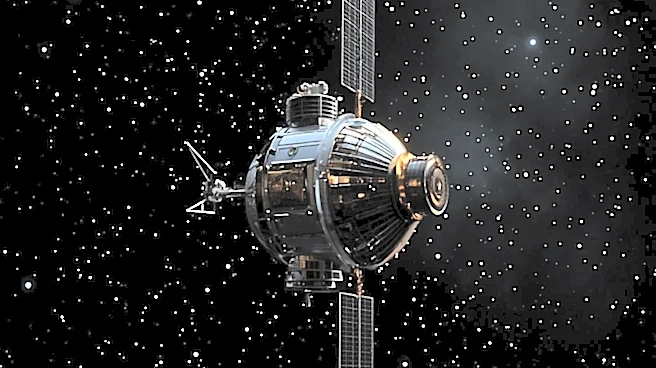
Mariner 4 was the fourth spacecraft in the Mariner program, specifically designated as Mariner-Mars 1964 along with its sister probe, Mariner 3. The Jet Propulsion Laboratory (JPL) was responsible for its production. The spacecraft itself was constructed around an octagonal magnesium frame, measuring 127 cm (50 inches) across its diagonal and 45.7 cm (18.0 inches) high. This central frame housed the electronic equipment, cabling, the midcourse propulsion system, and the attitude control gas supplies and regulators. Its design was robust, intended to withstand the rigors of a long-duration interplanetary flight.
Power for Mariner 4's instruments and radio transmitter was generated by 28,224 solar cells, distributed across four solar panels. These panels, each measuring 176 cm by 90 cm (69 inches by 35 inches), were capable of providing 310 watts of power at the distance of Mars. A rechargeable 1200 W·h silver-zinc battery served as a backup and provided power during maneuvers. The spacecraft's overall height reached 2.89 meters (9.5 feet), including its antennas and other extensions, making it a complex piece of engineering for its time.
Unveiling Mars: First Images and Scientific Revelations
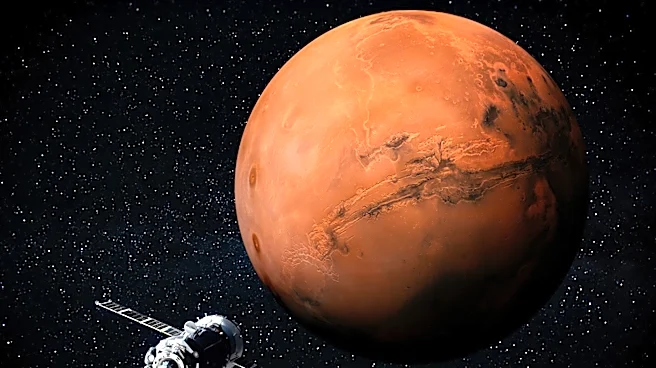
Mariner 4 performed the first successful flyby of Mars, capturing and returning the first close-up pictures of the Martian surface. These images, the first ever returned from deep space of another planet, depicted a cratered, seemingly dead world. This visual evidence significantly altered the scientific community's prevailing views on the potential for life on Mars, moving away from earlier, more optimistic assumptions.
Beyond imaging, the mission had other critical objectives. It was designed to perform field and particle measurements in interplanetary space, particularly in the vicinity of Mars. These measurements contributed to a broader understanding of the space environment between Earth and Mars. Furthermore, Mariner 4 was intended to provide invaluable experience and knowledge regarding the engineering capabilities required for long-duration interplanetary flights, paving the way for future, more ambitious missions. The mission, initially expected to last eight months, ultimately extended for about three years in solar orbit, demonstrating the spacecraft's remarkable durability and the ingenuity of its designers. Communications with Mariner 4 were finally terminated on December 21, 1967, leaving it derelict in a superior heliocentric orbit.
Technological Innovations for Deep Space Navigation
Mariner 4 incorporated several advanced technological features crucial for its deep space journey. For propulsion, it utilized monopropellant hydrazine, delivered via a four-jet vane vector control motor capable of producing 222-newton (50 lbf) thrust. Attitude control was maintained by 12 cold nitrogen gas jets, strategically placed on the ends of the solar panels, and three gyros. Solar pressure vanes, each with an area of 0.65 square meters (7.0 square feet), were also attached to the tips of the solar panels, contributing to stability.
One of the most significant navigational innovations was the use of a star, Canopus, as a reference object. Earlier missions, which remained closer to Earth, the Moon, or Venus, could rely on the bright faces of these bodies for positional information. However, for Mariner 4's journey to Mars, both Earth and Mars would become too dim to lock onto. Canopus, a bright star at a wide angle away from the Sun, fulfilled this requirement, becoming a crucial navigational beacon. This pioneering use of a star for deep space navigation set a precedent, with Canopus subsequently being used as a reference point in many following missions, underscoring Mariner 4's lasting impact on space technology.