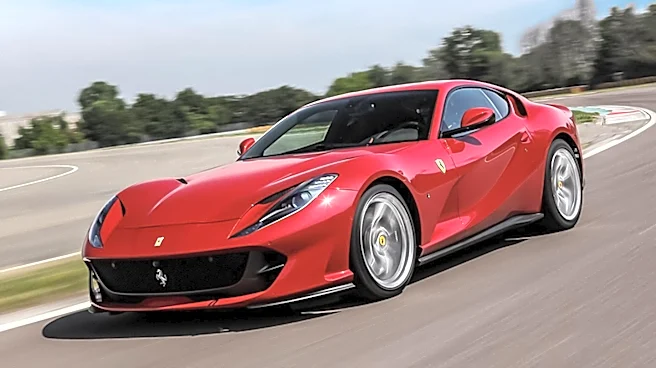



Ferrari has a rich and storied history in sports car racing, a journey that spans from the late 1940s to the present day. This Italian car manufacturer has consistently demonstrated its prowess on the track, achieving remarkable success in various international competitions. From its early victories in post-World War II Italy to its recent triumphs in endurance racing, Ferrari has cemented its reputation as a formidable force in the world of sports car racing.
The company's dedication to both Formula One and endurance racing, often with limited resources, stands as a testament to the passion and skill of its founder and the Scuderia team.
Early Dominance and Post-War Triumphs
Ferrari's entry into sports car racing was marked by immediate success, even during its startup phase in an impoverished post-World War II Italy. In 1948, the Ferrari 166 S secured victories at the Mille Miglia and the Targa Florio. The following year, 1949, proved to be an extraordinary season, with the 166 MM achieving a remarkable streak of wins at the Mille Miglia, the 12 Hours of Paris, the 24 Hours of Spa, the Targa Florio, and the 24 Hours of Le Mans. These victories were particularly impressive as the 2-liter Ferrari 166 MM competed against larger-engined sports cars and established marques. The 166 MM, especially in its iconic barchetta form, also made a significant impact on car design history, influencing later models like the Shelby Cobra.
This early success quickly established Ferrari as a brand of excellence, attracting wealthy and famous individuals who desired to own these winning machines. The streak of prestigious victories continued into the early 1950s, with wins at the Carrera Panamericana in 1951 and the Mille Miglia in both 1950 and 1951. During this period, Ferrari also began to achieve success in Formula One, showcasing its versatility across different racing disciplines. The company's ability to win at its first attempt at Le Mans and to triumph in all major races of the era underscored its burgeoning reputation.
The World Sportscar Championship Era
With the establishment of the World Sportscar Championship (WSC) in 1953, Ferrari, alongside other major manufacturers like Aston Martin, Maserati, Mercedes-Benz, and Jaguar, began to enter multiple factory-backed cars in prestigious races. These included events such as the Carrera Panamericana in Mexico, the 24 Hours of Le Mans in France, the Mille Miglia in Italy, the 24 Hours of Spa in Belgium, the Nürburgring 1000 km in Germany, and the Sicilian Targa Florio. To compete effectively, Ferrari launched a diverse range of sports racers over the next three years.
This impressive lineup included the traditional compact Colombo V12-powered Ferrari 250 MM, as well as larger V12 Lampredi-powered models such as the 340 MM, 375 MM, 375 Plus, and 410 S. The Jano-powered 290 MM, 315 S, and 335 S also contributed to their success. Additionally, Ferrari developed four-cylinder cars like the 500, 625, 750, and 860 Monzas, and six-cylinder models like the 376 S and 735 LM. This potent and varied collection of vehicles allowed Ferrari to claim six of the first seven WSC titles, winning in 1953, 1954, 1956, 1957, and 1958, demonstrating a period of significant dominance in international sports car racing.
The Ford vs. Ferrari War and Shifting Focus
The first half of the 1960s saw Ferrari continue its considerable success, notably achieving six consecutive overall wins at the 24 Hours of Le Mans from 1960 to 1965. With the introduction of the Sports Prototypes class, the team developed the Ferrari P series of cars. During this time, they faced limited competition from major manufacturers until the mid-1960s, with Porsche being a notable exception, though their smaller-engined cars were only competitive in specific races where lightness was prioritized over raw engine power, such as the Targa Florio or Nürburgring.
A pivotal moment arrived at the end of 1963, stemming from a conflict between Ferrari and Ford over a potential acquisition. This led to the famous "Ford vs. Ferrari war," a battle that profoundly impacted international motorsport. Ford decided to invest unprecedented amounts of money into developing a racing department in England with the explicit goal of defeating Ferrari in endurance races, leading to the creation of the Ford GT40. While Ferrari prevailed in the 1964 and 1965 championships and at Le Mans, they conceded victory to Ford in the 1966 championship and Le Mans race, where the 7-liter GT40 proved dominant. The 1967 season saw Ferrari win the championship but lose at Le Mans in a controversial race. A change in rules for the 1968 season, which denied participation to prototype cars, effectively ended the Ford vs. Ferrari battle in endurance racing. The 1970s marked the last decade Ferrari entered sports car racing as a works effort. Following an uninspired performance in the 1973 season, Enzo Ferrari ceased all development of sports cars in prototype and grand touring (GT) racing to focus entirely on Formula One, a decision that soon led to multiple Formula One titles.
Modern Era and GT Racing Success
After a period of absence from factory-backed sports car racing, Ferrari returned to GT car racing in 2006 with a factory effort called Ferrari Competizioni GT. This initiative involved partnerships with prominent racing teams such as AF Corse, Kessel Racing, and Risi Competizione. With factory support, these teams achieved significant success in major international GT2 and GTE Pro/GTLM competitions. AF Corse, in particular, won the GT2 manufacturers' title and the team's title every year it was contested in the FIA GT Championship, also securing two drivers' titles in 2006 and 2008.
Following the creation of the FIA World Endurance Championship (WEC) in 2012, Ferrari/AF Corse continued their impressive run in GT racing. Out of the ten GT manufacturers' championships contested since the WEC's inception, Ferrari won seven editions (2012, 2013, 2014, 2016, 2017, 2021, and 2022). They also claimed five out of nine GT drivers' titles awarded since the 2013 season (2013, 2014, 2017, 2021, and 2022), along with four out of six LMGTE PRO team trophies and numerous other victories in the LMGTE PRO/AM class and various international and national GT2/LmGTE and GT3 championships. Notable victories include two GT2 class wins at the 24 Hours of Le Mans in 2008 and 2009 by Risi Competizione, and four GTE Pro class wins by AF Corse at the same event, including in 2012, 2014, 2019, and 2021. A Ferrari 488 GT3 also secured overall wins at the 2017 12 Hours of Bathurst and the 2021 24 Hours of Spa.
Return to Top-Tier Endurance Racing
In 2023, after a 50-year hiatus, Ferrari made a significant return to the top class of endurance racing with its new Ferrari 499P, a Le Mans Hypercar prototype. This marked their re-entry into competing for the world title and in prestigious events like the 24 Hours of Le Mans, the 24 Hours of Daytona, and the 12 Hours of Sebring. The 499P was managed by AF Corse, leading to a restructuring of the team's GT activities. At the 2023 24 Hours of Le Mans, Ferrari achieved its first Le Mans victory since 1965 with the No. 51 499P. In the same year, a Ferrari 296 GT3 won the 24 Hours of Nürburgring. The success continued at the 2024 24 Hours of Le Mans, where Ferrari secured its eleventh victory, marking consecutive wins at Le Mans for the first time since 1965 with the No. 50 499P, while the No. 51 car finished third. The No. 83 499P further extended this winning streak in 2025, securing Ferrari's twelfth 24 Hours of Le Mans victory and contributing to their 2025 World Manufacturers' and Drivers' Championships.