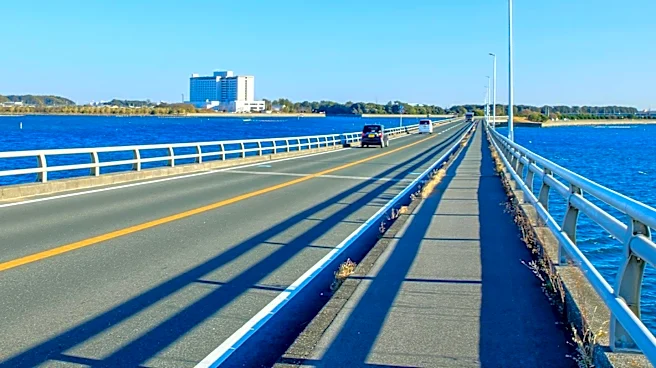








The Lake Pontchartrain Causeway, a dual-bridge system spanning Lake Pontchartrain in Louisiana, is not only an engineering marvel but also a critical artery for regional connectivity. Its robust construction has allowed it to withstand significant natural challenges, most notably Hurricane Katrina in 2005. The Causeway's ability to remain largely intact during such a devastating event highlights its structural integrity and its indispensable role
in the recovery efforts for the greater New Orleans metropolitan area. Beyond its physical resilience, the bridge has profoundly influenced the economic and social fabric of the communities it connects.
Withstanding Hurricane Katrina
On August 29, 2005, Hurricane Katrina, one of the most destructive hurricanes in U.S. history, made landfall, causing widespread devastation across the Gulf Coast. While many infrastructure elements in the region suffered catastrophic damage, the Lake Pontchartrain Causeway demonstrated remarkable resilience. Videos recorded after the hurricane showed damage to the bridge, but this was primarily confined to a less-used turnaround on the older southbound arch. Crucially, the fundamental foundations of the structure remained intact. This performance was a stark contrast to other major crossings, such as the I-10 Twin Span Bridge, which was extensively damaged.
The Causeway's ability to endure such a powerful storm meant it could quickly become a lifeline for recovery efforts. It served as the primary route for recovery teams, who had remained on higher ground to the north, to access New Orleans. Initially, the Causeway was reopened exclusively for emergency traffic. Subsequently, it was made accessible to the general public, with tolls temporarily suspended to facilitate movement. Toll collection was reinstated in mid-October, signaling a return to normalcy and the continued operational status of this vital link. The fact that the Causeway has never suffered major damage from hurricanes or other natural phenomena since its construction underscores its robust design and construction.
Broader Infrastructure Context in Louisiana
The Lake Pontchartrain Causeway is one of several significant highway spans in Louisiana that measure 5 miles (8.0 km) or more in total length. Other notable structures include the Manchac Swamp Bridge on I-55, the Atchafalaya Basin Bridge on I-10, the Louisiana Highway 1 Bridge, the Bonnet Carré Spillway Bridge on I-10, the Chacahoula Swamp Bridge on U.S. 90, the I-10 Twin Spans over Lake Pontchartrain, and the LaBranche Wetlands Bridge on I-310. The Maestri Bridge also approaches this length, falling short by only two-tenths of a mile. Additionally, Louisiana is home to the Norfolk Southern Lake Pontchartrain Bridge, which, at 5.8 miles (9.3 km), is one of the longest railway bridges in the United States.
Interestingly, some of these bridges, such as the Manchac Swamp Bridge, the I-10 Bonnet Carré Spillway Bridge, and the LaBranche Wetlands Bridge, are effectively contiguous, forming a single, continuous elevated roadway stretching over 38 miles (61 km). This network of long bridges highlights Louisiana's unique geographical challenges and its commitment to extensive infrastructure development to connect its communities. The Lake Pontchartrain Causeway, designated a National Historic Civil Engineering Landmark by the American Society of Civil Engineers in 2013, stands as a prime example within this impressive array of engineering achievements.