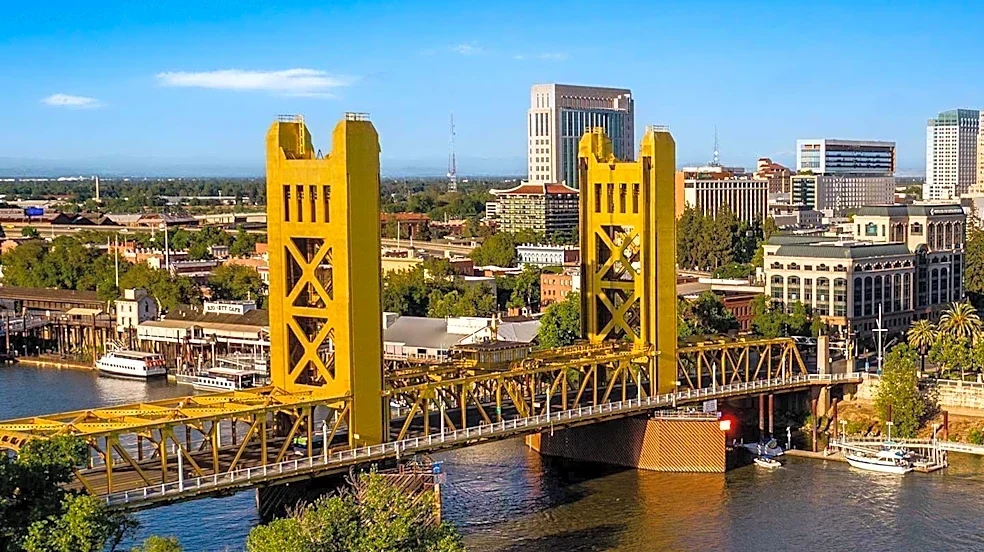







Sacramento's Tower Bridge, a distinctive vertical lift bridge, serves as a crucial link across the Sacramento River, connecting West Sacramento in Yolo County with the capital city of Sacramento in Sacramento County. Known previously as the M Street Bridge, it once formed part of U.S. Route 40 and U.S. Route 99W. Today, it is maintained by the California Department of Transportation as State Route 275, linking West Capitol Avenue and Cabaldon Parkway
in West Sacramento with the Capitol Mall in Sacramento. This bridge, added to the National Register of Historic Places in 1982, stands out for its rare use of Streamline Moderne architectural styling in a lift bridge, making it a significant expression of its construction era.
From Necessity to Architectural Statement
The need for the Tower Bridge became apparent as Sacramento's population more than doubled between 1910 and 1935, rendering the 1911 M Street Bridge inadequate. The original M Street Bridge was a swing through-truss railroad bridge, later modified with cantilevered roadway sections. Recognizing the need for a better crossing, especially in case of war, planning for the new bridge began in 1933. An agreement was reached in March 1934 between the State of California, Sacramento County, and the Sacramento Northern Railway, with construction commencing on July 20, 1934. The design aimed for both functionality and aesthetic appeal, featuring a 52-foot-wide roadway with sidewalks, and initially, single lanes for cars flanking a 13-foot center lane for trains.
Engineering and Inauguration
The Tower Bridge's design includes towers that are 160 feet tall. The bridge's structure comprises a 30-foot girder span, a 167-foot eastern truss approach span, a 209-foot central lift span, a 193-foot western approach span, and four 34-foot girder spans. When the draw is raised, it provides 100 feet of vertical clearance above high water, with a 172-foot-wide navigation channel. Despite the lift span weighing 1,150 short tons, it is operated by two relatively small 100-horsepower electric motors, thanks to an equal amount of counterweights located in each tower. The bridge's Streamline Moderne style, with its steel-sheathed lift span towers, earned it an honorable mention for the Class B prize bridge award from the American Institute of Steel Construction in 1935.
On December 15, 1935, then-governor Frank Merriam dedicated the bridge, leading an inaugural parade across it, famously accompanied by the release of 1,000 homing pigeons to spread the news across California. The first train had crossed the bridge on November 7, 1935, and it was formally accepted by the state on January 11, 1936, becoming the first vertical lift bridge in the California Highway System. The final trains ran over the bridge in 1962, and the railroad tracks were removed the following year, allowing the roadway to be restriped for four automobile lanes. A unique feature on the east side is a grade crossing designed as a secondary barrier, activating with a warning siren to block vehicular traffic when the bridge is raised.
A Bridge of Many Colors
Over the years, Sacramento's Tower Bridge has undergone several color transformations. Initially, it was painted with a silver aluminum paint, though this led to complaints about glare. The concrete pylons were originally sky-blue. In June 1976, as part of Bicentennial projects, the bridge was repainted a yellow-ochre color, chosen to match the gold-leafed cupola of the nearby State Capitol. By 2001, with the old paint fading, residents within 35 miles of the capital voted on a new color scheme. The options included all-gold; green, gold, and silver; or burgundy, silver, and gold. The winning choice was all-gold, and the bridge was repainted in 2002. This decision, however, sparked further debate, with some residents feeling the new paint wasn't as gilded as advertised, and others suggesting copper as a better choice. The current gold coat is expected to last for 30 years.