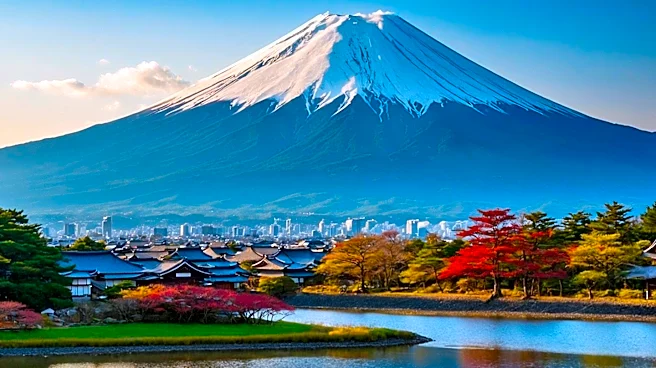
Mount Fuji, or Fuji-san, is a prominent geographical feature of Japan, recognized as the highest mountain on the island of Honshu and throughout the entire Japanese archipelago. This active volcano, despite its low risk of eruption, is a significant geological landmark. Its distinctive volcanic cone is frequently snow-capped, contributing to its iconic status. Located west of Tokyo, Mount Fuji is visible from the capital city on clear days, marking
a striking presence on the landscape. Its position near the Pacific Ocean coast of Honshu, straddling the border between Shizuoka and Yamanashi prefectures, places it within a region of notable natural beauty and geological interest.
Location and Surrounding Areas
Mount Fuji's geographical placement is quite specific, situated on the border between the Shizuoka and Yamanashi prefectures. This strategic location means it is surrounded by several smaller cities that benefit from its proximity. To the east lies Gotemba, to the north Fuji-Yoshida, and to the southwest, Fujinomiya. These towns serve as gateways for the numerous climbers and tourists who visit the mountain annually, drawn by its natural splendor and cultural significance. The mountain's isolation, measured at 2,077 kilometers, further emphasizes its dominance within the regional topography, making it a truly standalone peak.
Physical Characteristics and Volcanic Nature
Standing at an impressive altitude of 3,777.24 meters (approximately 12,388 feet), Mount Fuji is classified as an active stratovolcano. Its conical shape is a classic example of this type of volcano, formed by layers of hardened lava, tephra, and volcanic ash. Despite being active, it is currently considered to have a low risk of eruption, a status that allows for its continued accessibility and popularity. The mountain's prominence, also 3,776 meters, indicates that it rises significantly from its surrounding terrain, with no higher parent peak nearby, underscoring its singular grandeur.
The Enigmatic Aokigahara Forest
At the base of Mount Fuji lies the Aokigahara forest, a unique natural area known for its caves that remain frozen even during the summer months. This forest has been the subject of various legends and misconceptions. One popular myth suggests that the mountain's rocks contain large iron deposits that interfere with compasses, causing people to get lost easily. However, this is untrue; the magnetic field generated by any iron deposits is too weak to significantly affect compasses. Military forces from Japan and the United States regularly conduct training exercises in Aokigahara, during which GPS, compasses, and other electronic navigation devices function perfectly. Beyond these scientific debunkings, the forest is also steeped in folklore, with tales of monsters, ghosts, and goblins said to haunt its depths. This blend of natural wonder and local legend adds another layer of intrigue to the geographical landscape surrounding Mount Fuji.