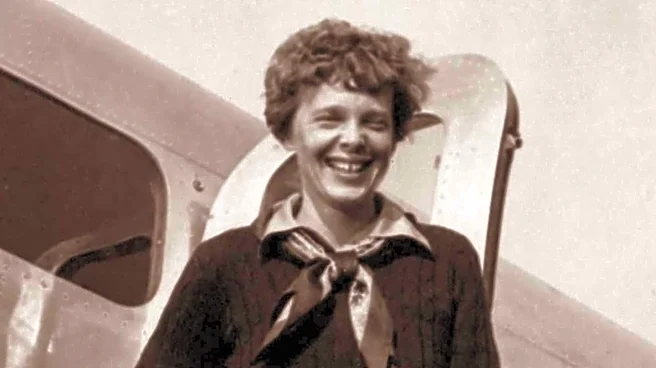

Amelia Earhart, an American aviator and aviation pioneer, became one of the most celebrated figures of early flight, particularly after her groundbreaking 1928 transatlantic journey. While she was initially
a passenger on this historic flight, the event launched her into international prominence and significantly shaped public perceptions of women in aviation. This journey, though not a solo piloting feat for Earhart, laid the groundwork for her future achievements and cemented her status as a cultural icon.
The Genesis of a Historic Journey
In early 1928, American heiress Amy Phipps Guest, inspired by Charles Lindbergh's successful solo transatlantic flight the previous year, announced her intention to become the first woman to cross the Atlantic by air. Living in London with her husband, former British air minister Frederick Guest, she leveraged her wealth and social connections to assemble a team of aviation professionals. Guest hired pilot Wilmer Stultz to lead the flight, who had recently made headlines for a non-stop flight from New York to Havana. She also recruited mechanic and co-pilot Louis Gordon and acquired a Fokker F.VIIb Tri-Motor aircraft from Commander Richard E. Byrd, naming it *Friendship* to symbolize the relationship between the United States and Great Britain.
However, Guest's family reacted with alarm to her plans, with her sons even threatening to quit their universities. Under this family pressure, Guest reluctantly abandoned her dream of making the flight herself. Despite this, she remained determined to see a woman achieve the milestone and resolved to sponsor the project, beginning a search for what she termed "the right sort of girl." The ideal candidate needed to be a pilot, well-educated, well-mannered, physically attractive, and American.
Selection and Conditions for Amelia Earhart
George Palmer Putnam, a publicist and publisher known for Charles Lindbergh's autobiography, learned of the planned transatlantic attempt in April 1928. Through his friend Captain Hilton Railey, Putnam investigated and discovered Amy Guest's true purpose for the newly outfitted seaplane. Putnam and Railey took on the task of finding the suitable woman for Guest. Railey reached out to Rear Admiral Reginald R. Belknap in Boston, who, upon hearing the criteria, immediately suggested Amelia Earhart from Denison House.
Upon receiving Railey's call, Earhart was initially skeptical but agreed to meet him. Railey was convinced he had found the right woman and promptly asked her if she would like to be the first woman to cross the Atlantic. Earhart later wrote that under the circumstances, she couldn't say no. However, she had conditions: she made it clear that the role of a mere passenger held no appeal. She wanted the opportunity to take her turn at the controls. Despite her lack of experience with multi-engine aircraft and non-visual instrument flying, it was agreed that, weather permitting, she would be allowed to pilot the aircraft for a portion of the journey. Her flight contract stipulated that Earhart would hold the title of commander aboard *Friendship*, granting her final authority over all matters of policy, procedure, and personnel until their arrival in London. Both Wilmer Stultz and Louis Gordon would serve as her subordinates during the flight.
The Transatlantic Journey and Its Aftermath
After several delays due to weather and mechanical issues, *Friendship* finally took off from Trepassey, Newfoundland, on June 17, 1928. Early in the flight, the crew encountered fog, cloud cover, and poor visibility, forcing pilot Wilmer Stultz to rely entirely on instrument flying. Earhart, lacking experience in instrument-only flying, kept the flight log and assisted with navigation checks, while mechanic Louis Gordon managed fuel and engine performance. Critically, the aircraft's radio failed early in the flight, preventing them from confirming their course or receiving weather updates.
After nearly 21 hours in the air, with low fuel and limited visibility, the crew landed in the Burry Estuary in Carmarthenshire, Wales. Earhart declined to go ashore immediately, intending to do so only if the flight continued as planned. However, after discussions about fuel and conditions, the decision was made to take *Friendship* to Burry Port Harbour, officially concluding her transatlantic journey. This secured her place in history as the first woman to cross the Atlantic by air. Despite her limited role as a passenger, her modesty and charisma, coupled with the media's focus on her, quickly propelled her to fame, surpassing that of her fellow crew members. Upon returning to the United States, Earhart and the crew were met with widespread acclaim, including a ticker-tape parade in New York City and a reception at the White House by President Calvin Coolidge. Earhart later authored a book about the flight, *20 Hrs. 40 Min.: Our Flight in the Friendship*, further solidifying her public image and paving the way for her subsequent solo transatlantic flight in 1932.