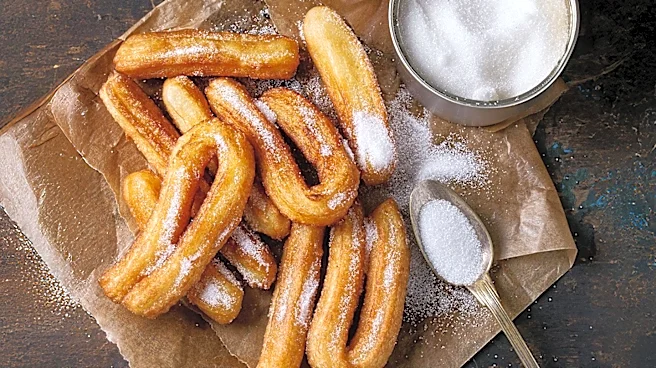









The churro, a fried dough pastry enjoyed across many cultures, boasts a history that is surprisingly long and complex. While its exact origins remain somewhat unclear, food historians suggest that its roots might stretch back to ancient times, evolving from simple flour and water fritters. This beloved treat has traveled across continents, adapting to local tastes and culinary traditions, ultimately becoming a staple in Spanish, Portuguese, Latin
American, and even Philippine cuisines, among others.
Ancient Roots and Early Theories
According to food historian Michael Krondl, the modern churro shares similarities with a flour and water fritter recipe found in Apicius, a Roman cookbook from the 1st century AD. This suggests that the concept of fried dough has been around for a very long time, possibly even predating the Romans, with recipes from the Ancient Greeks indicating an even older lineage. The Mediterranean basin, in particular, seems to have a long-standing tradition of such preparations.
One theory, though considered unlikely by some, suggests that Spanish shepherds created churros as a substitute for fresh baked goods. The idea was that churro paste was easy to make and fry over an open fire in the mountains, where shepherds spent much of their time. However, the nomadic lifestyle of shepherds and the significant amount of oil or fat required for frying make this particular origin story less probable.
The Asian Connection and European Adaptation
Another theory, which some consider a hoax, proposes that the concept of the churro was brought to Europe from China by the Portuguese. As Portuguese explorers returned from Ming-dynasty China, they are said to have introduced new culinary techniques, including a method for altering dough similar to that used for youtiao, also known as yóuzháguǐ in southern China. This Chinese fried dough bears a resemblance to the churro, suggesting a possible influence.
This new pastry was reportedly introduced to Spain, where it underwent a significant modification. Instead of being pulled, the dough was extruded through a star-shaped nozzle, similar to a piping bag, giving the churro its distinctive ridged appearance. This innovation marked a key step in the development of the churro as we know it today, distinguishing it from its potential Chinese predecessor.
Global Spread and Regional Variations
From its Iberian origins, the churro spread widely, particularly to areas that experienced immigration from Spanish- and Portuguese-speaking countries. This includes Latin America, the Southwestern United States, and even France and the Philippines. In these regions, the churro has been embraced and adapted, leading to a diverse array of preparations and fillings.
For instance, filled churros are popular in many Latin American countries. In Cuba, they might be filled with fruit like guava, while in Brazil, chocolate or doce de leite are common fillings. Argentina, Bolivia, Peru, Chile, and Mexico often feature churros filled with dulce de leche or cajeta, as well as chocolate and vanilla. Colombia and Venezuela offer fillings like bocadillo, arequipe, or sweetened condensed milk. In Spain, a wider diameter is sometimes used to accommodate these fillings. The Philippines, for its part, typically serves straight, U-shaped, or circular churros dusted with white sugar, especially popular during Christmas. Uruguay even offers a savory version filled with melted cheese, showcasing the incredible versatility and global appeal of this fried dough pastry.