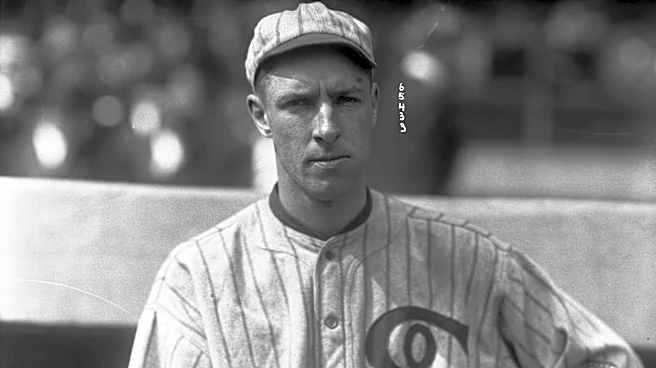







Jesse Tannehill was a professional baseball pitcher who played a significant role with the Boston Americans during their early, successful years in the American League. As a member of the 1904 American League champion team, Tannehill contributed to a formidable pitching staff and a roster filled with notable talent. His time with the Americans placed him directly within a pivotal era of baseball history, where the team established itself as a dominant
force, securing championships and featuring some of the sport's most legendary figures.
A Key Arm in the 1904 Rotation
In the 1904 season, Jesse Tannehill held a crucial position as the fourth starter in the Boston Americans' pitching rotation. This placed him among an elite group of pitchers, including the legendary Cy Young, Bill Dinneen, and Norwood Gibson. The team's depth was further highlighted by George Winter, who served as the fifth starter. Winter, despite his lower ranking in the rotation, still appeared in 20 games that year, compiling a respectable 8-4 record, demonstrating the overall strength and talent available to the Americans' manager, Jimmy Collins.Tannehill's presence in this rotation meant he was pitching alongside one of the game's all-time greats, Cy Young. Young's performance in this period was nothing short of spectacular. In 1904, he pitched a perfect game against the Philadelphia Athletics, a monumental achievement that was the first perfect game in American League history under modern rules. This perfect game was part of an incredible pitching streak where Young set major league records for consecutive scoreless innings pitched and consecutive innings without allowing a hit, the latter record still standing at 25 and one-third innings, or 76 hitless batters. Even after allowing a hit, Young's scoreless streak reached a then-record 45 shutout innings, underscoring the high caliber of pitching Tannehill was associated with.
Member of a Championship Dynasty
As a member of the 1904 Boston Americans, Jesse Tannehill was part of an American League championship team. This victory followed closely on the heels of the team's triumph in the first modern World Series in 1903, where they defeated the Pittsburgh Pirates. Although Tannehill is not explicitly mentioned as playing in the 1903 World Series, his presence on the 1904 roster indicates his continued importance to a team that was consistently at the pinnacle of the league. The Americans' success in these consecutive years solidified their reputation as a powerhouse in early professional baseball.The 1904 championship roster, which included Tannehill, was a collection of significant talent managed by Jimmy Collins. Alongside Tannehill and the pitching staff, the team featured players such as Lou Criger, Patsy Dougherty, Duke Farrell, Hobe Ferris, Buck Freeman, Candy LaChance, Freddy Parent, Kip Selbach, and Chick Stahl. This ensemble of players contributed to the team's ability to secure the American League pennant, showcasing a blend of offensive and defensive prowess that complemented their strong pitching. Tannehill's inclusion among these names underscores his role in a truly successful and memorable baseball squad.
Playing Alongside Baseball Icons
Jesse Tannehill's career with the Boston Americans provided him the unique opportunity to play alongside and contribute to a team featuring Cy Young, a pitcher whose legacy would become synonymous with excellence in baseball. Young's impact on the game was immense; he led the American League in wins, strikeouts, and ERA in 1901, earning him the colloquial AL Triple Crown for pitchers. He also threw the first pitch in modern World Series history in 1903. Young's eventual election to the National Baseball Hall of Fame and the creation of the Cy Young Award in his honor further highlight the legendary status of his teammate, placing Tannehill within the orbit of one of the sport's most celebrated figures.Being part of such a distinguished team meant Tannehill was involved in a period of significant achievement for the Boston Americans. The team's consistent performance, including their 1903 World Series win and 1904 American League championship, demonstrated a collective strength that relied on contributions from every player, including its starting pitchers. Tannehill's role as the fourth starter in 1904 was a testament to his skill and reliability within a pitching staff that was arguably one of the best in the league, contributing to the team's overall dominance during this foundational era of professional baseball.