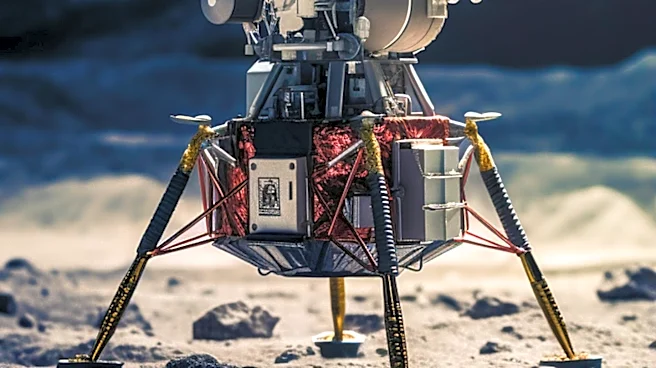









The Surveyor 5 mission, part of the American uncrewed Surveyor program, achieved a successful lunar soft landing despite facing a critical technical challenge. Launched on September 8, 1967, this lunar lander was designed to explore the Moon's surface and gather crucial data in preparation for crewed Apollo landings. However, a helium leak threatened to derail the mission, forcing engineers to devise an improvised landing sequence that ultimately
secured its success in Mare Tranquillitatis.
The Critical Helium Leak
Early in its mission, Surveyor 5 encountered a significant problem: a helium leak within the system responsible for pressurizing the liquid-fuel vernier engines. These engines were vital for controlling the spacecraft's descent and achieving a soft landing on the lunar surface. A substantial leak in this system could have led to a catastrophic failure, as insufficient pressure would have shut down the engines, causing the lander to crash.
The vernier engines were designed to operate with a specific helium pressure to ensure proper fuel delivery and thrust control. The integrity of this pressurization system was paramount for the precise maneuvers required during the final stages of lunar descent. The detection of this leak presented a severe challenge to the mission controllers, who had to quickly assess the situation and formulate a plan to compensate for the compromised system.
Improvised Landing Sequence
To counteract the helium leak and ensure a successful landing, an improvised landing sequence was implemented. Typically, the retrorocket, which provides the initial significant deceleration, would fire at a higher altitude. However, for Surveyor 5, the retrorocket was started at just 42 kilometers above the Moon, approximately half the usual height. This adjustment was critical because it allowed the vernier engines to take over at a much lower altitude and for a shorter duration.
The vernier engines then brought the craft down in 106 seconds from a height of only 1340 meters, which was about 10% of the usual height for this phase of the descent. This shortened vernier flight sequence was a direct response to the helium pressure issue. By reducing the time the vernier engines needed to operate, the mission aimed to conserve the dwindling helium pressure, bringing the craft down with a pressure level that was right on the edge of what would have caused the engines to fail due to lack of pressure.
Mission Objectives and Scientific Contributions
Despite the in-flight anomaly, Surveyor 5 successfully achieved its primary objectives. It transmitted a total of 19,118 images back to Earth, providing valuable visual data of the lunar surface. Beyond imaging, the mission also conducted a Vernier engine erosion experiment, gathered touchdown dynamics data, and obtained thermal and radar reflectivity data. A key scientific instrument onboard was a miniature chemical analysis lab utilizing an alpha particle backscatter device.
This alpha-scattering instrument was used to determine the chemical composition of the lunar surface soil, revealing it to consist of basaltic rock. This was a significant finding, contributing to the understanding of lunar geology. A small bar magnet attached to one footpad was also included to detect any magnetic material in the lunar soil. The successful landing and operation of Surveyor 5, even with the helium leak, demonstrated the resilience and ingenuity of the American space program, paving the way for future crewed missions like Apollo 11, which would land just 25 kilometers south-southwest of Surveyor 5 less than two years later.