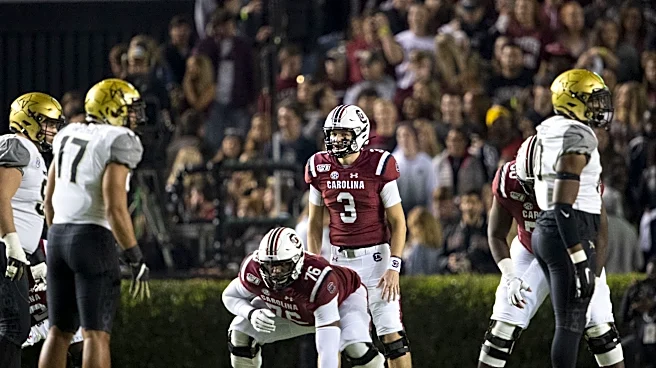


Steve Spurrier's eleven-year tenure as the head coach of the South Carolina Gamecocks, from 2005 to 2015, marked a significant period of growth and unprecedented success for the university's football program. Arriving with a reputation as an innovative offensive strategist, Spurrier took a team not widely expected to achieve winning seasons and quickly began to reshape its identity. His leadership led the Gamecocks to become consistently bowl eligible,
achieve their first-ever division title, and record multiple eleven-win seasons, milestones that had previously eluded the program. This era is remembered for elevating South Carolina football to new heights within the competitive Southeastern Conference (SEC).
Early Impact and Historic Wins
In his inaugural 2005 season, Spurrier immediately made an impact, guiding the Gamecocks to a 7–5 record. This included a remarkable five-game SEC winning streak, a first in the program's fourteen-year SEC history. Among these victories were two particularly historic upsets: a 16–15 win at Tennessee, marking South Carolina's first-ever victory in Knoxville, and a 30–22 triumph over then 12th-ranked Florida, a team South Carolina had not beaten since 1939. These early successes earned Spurrier the Associated Press SEC Coach of the Year award and culminated in a trip to the Independence Bowl, though they lost to Missouri 38–31. This initial season set a new tone and demonstrated Spurrier's ability to quickly turn a program around.
Spurrier's arrival followed a period where the Gamecocks had seen mixed results under previous coaches. Lou Holtz, who preceded Spurrier, had achieved eight-win seasons in 2000 and 2001 but saw regression in the subsequent years. Spurrier, after a brief stint with the Washington Redskins and a year off, was considered a highly attractive free agent in the coaching market. His decision to join South Carolina signaled a new chapter for the program, bringing with him a history of success from his time at Florida and Duke, where he had also achieved significant milestones.
Milestones and Sustained Success
The early 2010s represented the pinnacle of Spurrier's time at South Carolina. The Gamecocks secured their first-ever division title in 2010, a testament to the sustained improvement under his guidance. This achievement was followed by an extraordinary run of three consecutive eleven-win seasons in 2011, 2012, and 2013. This level of consistent high performance was unprecedented for the program, establishing South Carolina as a formidable contender in the SEC East. The 2013 season, in particular, saw the Gamecocks achieve their highest final ranking in school history, finishing at No. 4 nationally.
During this period, Spurrier's teams regularly beat their biggest rivals, often accompanied by his characteristic "zingers" and jokes that amused his fans but infuriated opponents. His ability to motivate and strategize led to memorable victories, including a school-record fifth consecutive win against Clemson in 2013. The 2013 team also featured a statistically best offense in school history, averaging 34.1 points and a record 452.3 yards per game, showcasing Spurrier's enduring influence as an offensive innovator. Quarterback Connor Shaw, under Spurrier's tutelage, became a semifinalist for the Davey O'Brien Award, and running back Mike Davis achieved the fourth-highest single-season rushing total in school history.
The "Miracle at Mizzou" and Program Legacy
A defining moment of the 2013 season, and perhaps Spurrier's tenure, was the "Miracle at Mizzou." Facing undefeated No. 5 Missouri on the road, the Gamecocks fell behind 0–17. An injured Connor Shaw entered the game to replace Dylan Thompson and orchestrated a remarkable 17-point comeback in the fourth quarter, forcing overtime. South Carolina ultimately won in double overtime after Missouri's kicker missed a field goal, marking the program's first-ever overtime victory. This game encapsulated the resilience and competitive spirit that Spurrier instilled in his teams.
Spurrier's overall record at South Carolina was 86–49, making him the winningest head coach in program history. He was named SEC Coach of the Year twice during his tenure, in 2005 and again in 2010. His leadership brought a new level of national recognition and competitive consistency to the South Carolina Gamecocks. Although the team regressed in his final two years, leading to his resignation in 2015, the impact of his eleven seasons remains a significant chapter in the program's history, characterized by groundbreaking achievements and a transformation of expectations for South Carolina football.