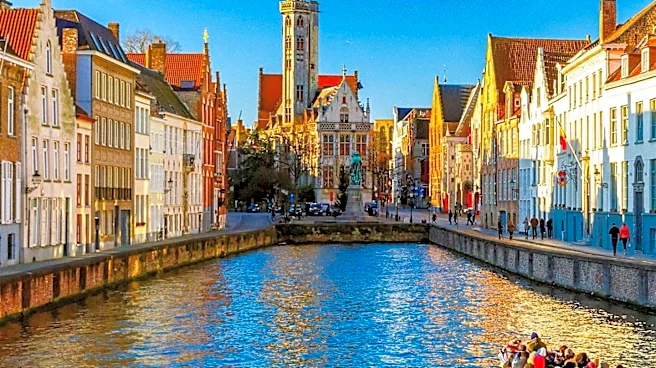






Bruges, the capital of West Flanders in Belgium, is often celebrated as the "Venice of the North" due to its distinctive canal-based layout. This aquatic geography was not merely aesthetic; it was fundamental to the city's historical development, economic prosperity, and even its political identity. From its early days as a strategic stronghold to its golden age as a major European trading hub, Bruges' relationship with water, particularly the Zwin
inlet, dictated its fortunes. This connection also fostered a strong sense of local identity, evident in its resistance against foreign powers and the establishment of its own robust civic structures.
The Lifeline of the Zwin and Urban Development
Bruges' existence and growth were profoundly shaped by its access to the sea. Initially, around 1050, the city faced the challenge of gradual silting, which threatened to cut off its direct maritime links. However, a significant storm in 1134 proved to be a turning point, creating a natural channel at Het Zwin, often called the "Golden Inlet." This new sea arm extended inland to Damme, which rapidly became Bruges' vital commercial outpost. This natural waterway allowed Bruges to become the only Flemish cloth town with direct access to the North Sea, a crucial advantage for trade.
With this renewed access, Bruges received its city charter in 1128, leading to the construction of new walls and canals that further integrated water into its urban fabric. The city's entrepreneurs capitalized on this by developing sophisticated trade networks. Hanseatic ships, carrying goods from northern Europe, filled the harbor, which eventually had to be expanded beyond Damme to Sluys to accommodate larger vessels. This constant interaction with maritime trade solidified Bruges' identity as a port city, where water was both a conduit for wealth and a defining feature of its landscape.
A Hub for International Merchants and Cultural Exchange
Bruges' canal system and port facilities made it an attractive destination for merchants from across Europe, fostering a cosmopolitan environment. The city became a crossroads for the northern Hanseatic League trade and southern European routes. In 1277, the arrival of the first merchant fleet from the Republic of Genoa established Bruges as a primary link to Mediterranean trade, bringing not only spices but also advanced commercial and financial techniques. Later, Venetian galleys also frequented its port, further cementing its role as an international trading center.
This influx of diverse merchants, including Castilians and Basques, contributed to a rich cultural tapestry. These foreign communities often maintained their own laws and customs within the city, highlighting Bruges' capacity to integrate diverse populations while maintaining its distinct Flemish character. The city's wealth, generated through this extensive trade, also attracted artists, bankers, and prominent personalities, particularly in the 15th century when Philip the Good, Duke of Burgundy, established a court there. This period saw the rise of the Flemish school of oil painting, gaining world renown and showcasing Bruges as a center of artistic innovation.
Civic Identity and Resistance
The prosperity brought by trade also fueled a strong sense of civic identity and, at times, social upheaval. The city's autonomous administration, gained by the 12th century, allowed it to develop its own institutions. This independence was fiercely protected. In 1302, the "Bruges Matins" saw the local Flemish militia massacre the French garrison, leading to a joint effort with the Count of Flanders against the French, culminating in the victory at the Battle of the Golden Spurs. This event, commemorated by a statue of leaders Jan Breydel and Pieter de Coninck in the Big Market square, underscores the city's commitment to its Flemish identity and its willingness to defend its autonomy.
Bruges maintained a permanent paramilitary militia, closely tied to guilds, which provided both security and a symbol of civic pride. This blend of economic power, strategic geography, and a strong, independent spirit defined Bruges throughout its golden age. Even as the Zwin began to silt up again in later centuries, leading to a decline in its direct maritime access, the legacy of its water-based commerce and its resilient Flemish identity remained central to its historical narrative.