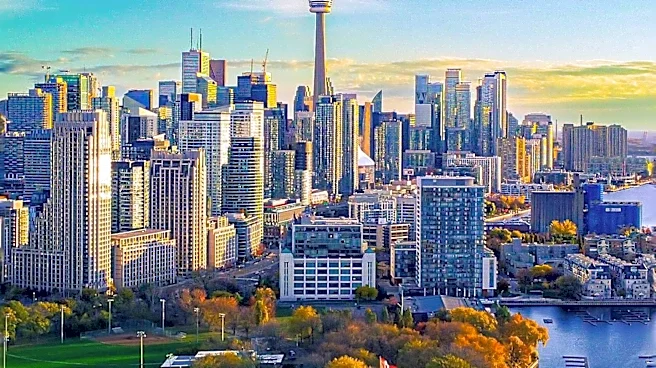







Toronto, the capital city of Ontario, Canada, stands as a testament to cultural diversity and global engagement. With a 2021 population of 2,794,356, it is the most populous city in Canada, a characteristic that contributes significantly to its vibrant multicultural fabric. The city's motto, "Diversity Our Strength," encapsulates its core identity, reflecting a long history of welcoming people from various backgrounds and integrating them into its society.
This commitment to diversity, coupled with its strategic location and institutional prominence, has cemented Toronto's status as a globally recognized urban center.
A Melting Pot of Cultures and Peoples
Toronto's history is marked by successive waves of immigration that have shaped its demographic and cultural landscape. In the second half of the 19th century, the city became a major destination for immigrants to Canada. The Great Irish Famine led to a significant influx of Irish immigrants, predominantly Catholic, who by 1851 constituted the largest single ethnic group in the city. This period also saw the arrival of Protestant Irish immigrants, some from what is now Northern Ireland, whose influence, particularly through the Orange Order, was substantial in municipal politics for decades.
Later, from the late 19th into the early 20th century, Toronto welcomed new European groups, including Germans, French, Italians, and Jews. These were followed by Russians, Poles, and other Eastern European nations, as well as Chinese immigrants arriving from the West. Many of these newcomers initially settled in overcrowded areas, such as "the Ward," which was centered on Bay Street, now the heart of the country's Financial District. As these migrant communities prospered, they moved to better housing, illustrating a dynamic pattern of settlement and integration that continues to define Toronto's diverse neighborhoods.
Global Aspirations and International Recognition
Toronto's global connections extend beyond its diverse population to its role on the international stage. The city has been a candidate for major global events, vying for the 1996 and 2008 Summer Olympics, which were ultimately awarded to Atlanta and Beijing, respectively. While not securing the Summer Olympics, Toronto did host the Summer Paralympics in 1976, demonstrating its capacity for large-scale international events. Looking ahead, Toronto is set to host matches during the 2026 FIFA World Cup, an event that will further highlight its global appeal and infrastructure.
These international engagements underscore Toronto's ambition and capability to participate in and host world-class events, drawing global attention and fostering international relationships. The city's strategic location on the northwest side of Lake Ontario also positions it as a significant gateway, historically linking the world to the interior of the North American continent through its expanding port and rail facilities. This blend of internal diversity and external engagement makes Toronto a truly global city, where different cultures converge and international events find a welcoming home.