







Elvis Presley's career was marked by distinct phases, each presenting new challenges and opportunities that shaped his public image and musical output. From his unexpected conscription into the U.S. Army to his decade-long immersion in Hollywood filmmaking, and ultimately, his triumphant return to the stage, these years were pivotal in defining his enduring legacy. This period saw Presley navigate personal loss, professional shifts, and a powerful
resurgence that reminded the world of his unparalleled talent as a live performer.
Military Service and Personal Loss
On March 24, 1958, Elvis Presley was drafted into the United States Army, an event that garnered significant media attention. He expressed a desire to be treated like any other soldier, and during his service, he was assigned to the 1st Medium Tank Battalion, 32d Armor, 3d Armored Division, in West Germany, serving as an armor intelligence specialist. He was promoted to private first class in November 1958 and to specialist fourth class in June 1959, eventually reaching the rank of sergeant in February 1960. Fellow soldiers attested to his wish to be seen as an ordinary soldier and noted his generosity, as he donated his Army pay to charity, purchased televisions for the base, and bought extra fatigues for his unit. During his time in the military, Presley was introduced to amphetamines, which he found beneficial for energy and weight loss, and developed a lifelong interest in karate, later incorporating it into his live performances.
His military service was also marked by profound personal tragedy. In early August 1958, while Presley was undergoing training at Fort Hood, Texas, his mother, Gladys, was diagnosed with hepatitis, and her condition rapidly worsened. He was granted emergency leave to visit her in Memphis, arriving on August 12. Two days later, she died of heart failure at the age of 46. Presley was devastated by her death, and their extremely close relationship, characterized by baby talk and pet names even into his adulthood, left an indelible mark on him. He returned to the U.S. on March 2, 1960, and was honorably discharged three days later. His return was met with immense public enthusiasm, with crowds mobbing the train that carried him from New Jersey to Tennessee.
The Hollywood Years: Focus on Films
Upon his return from military service, Presley relaunched his recording career with immediate commercial success, including the number-one hit "Stuck on You." However, under the guidance of his manager, Colonel Tom Parker, much of the 1960s saw Presley's career shift primarily to filmmaking. He starred in 27 films during this decade, most of which were formulaic, modestly budgeted musical comedies. While Presley initially sought more dramatic roles, the lesser commercial success of films like "Flaming Star" (1960) and "Wild in the Country" (1961) led him back to the established formula. These films were almost universally panned by critics, with one critic dismissing them as a "pantheon of bad taste." Despite this, they were highly profitable, leading producer Hal Wallis to declare, "A Presley picture is the only sure thing in Hollywood."
The rapid production and release schedule of these films—Presley often starred in three a year—significantly impacted his music. Many of his soundtrack albums were critically derided, with the quality of the songs progressively worsening over the decade. Musicians like Gordon Stoker of The Jordanaires noted that Presley himself disliked many of the songs and would retreat from the studio microphone. While a few popular songs emerged from his films, such as "Can't Help Falling in Love" (1961) and "Return to Sender" (1962), his non-film musical output was limited. Between 1962 and 1968, only one LP of new material, the gospel album "How Great Thou Art" (1967), was released, earning him his first Grammy Award for Best Sacred Performance. This period also saw his marriage to Priscilla Beaulieu on May 1, 1967, after more than seven years of knowing each other.
The '68 Comeback Special and Las Vegas Residency
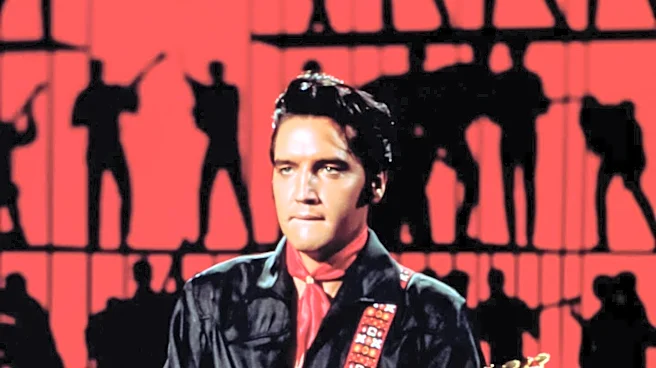
By 1968, Presley had grown deeply unhappy with his career, and his musical output was struggling, with only two of his eight singles charting in the top 40. Colonel Parker, recognizing the need for a change, orchestrated a deal with NBC for Presley's first television special. Recorded in late June in Burbank, California, and aired on December 3, 1968, the special, simply titled "Elvis" and later known as the '68 Comeback Special, was a pivotal moment. It featured lavishly staged studio productions and intimate performances with a band in front of a small audience—his first live performances since 1961. Dressed in tight black leather, Presley's uninhibited style was reminiscent of his early rock and roll days, captivating 42 percent of the total viewing audience and becoming NBC's highest-rated show that season. Director Steve Binder worked to create a show far removed from Parker's original plan for an hour of Christmas songs.
The success of the Comeback Special revitalized Presley's career. Buoyed by this experience, he engaged in prolific recording sessions at American Sound Studio, resulting in the acclaimed album "From Elvis in Memphis," released in June 1969. This was his first secular, non-soundtrack album from a dedicated studio period in eight years, featuring hit singles like "In the Ghetto" and "Suspicious Minds." The special also led to an extended Las Vegas concert residency. In May 1969, the brand-new International Hotel in Las Vegas booked Presley for 57 shows over four weeks. Despite initial nervousness, his debut performance was met with a standing ovation from an audience that included many celebrities. Newsweek commented on his "staying power," and Rolling Stone called him "supernatural." This residency, which saw him perform two shows a night, became a hallmark of his later career, with recordings from these shows released on the album "On Stage." His stage costume, particularly the jumpsuit, became a trademark of his live act, further cementing his iconic status as "The King." This period marked a powerful return to his roots as a live performer, demonstrating his enduring appeal and musical versatility.