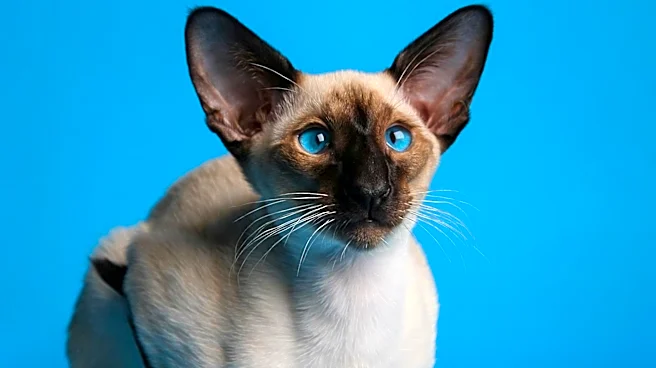







The Siamese cat, a breed originating from Thailand, has undergone a significant transformation over the past century, leading to distinct physical types recognized today. Initially introduced to the Western world in the 19th century, these cats quickly gained popularity for their unique appearance and personality. However, selective breeding practices led to a divergence in their physical characteristics, ultimately resulting in the modern Siamese and the re-establishment
of the traditional "old-style" as the Thai cat. This evolution highlights the dynamic nature of breed development within the cat fancy community.
Early Popularity and the Shift in Type
During the 19th century, the Siamese cat became one of the most popular breeds in both Europe and North America. These early imports, derived from the Wichianmat landrace native to Thailand (then known as Siam), were admired for their distinctive colorpoint coats, blue almond-shaped eyes, and an elongated, slender, and muscular body. They were also characterized by a triangular wedged head shape and large, wide-set ears. The breed's unique features set it apart from other domestic cats of the time.
As the 20th century progressed, particularly around the 1950s, a preference emerged among Siamese enthusiasts for a more extreme, modern-style body. This new ideal emphasized even more slender and angular features, pushing the breed's conformation further from its original, rounder build. This shift in preference was driven by breeders aiming to accentuate what they considered the most distinctive qualities of the Siamese, leading to a more refined and elongated appearance that became dominant in cat shows.
The Emergence of the Thai Cat
The increasing emphasis on the modern, extreme-featured Siamese eventually led to a movement to preserve the original, more moderate type. From the 1980s onwards, the traditional "old-style" Siamese, characterized by a rounder build, began to officially separate from the modern Siamese breed. Multiple registries re-established these cats as a distinct breed, known as the Thai cat. This re-establishment was a conscious effort to maintain the characteristics of the cats originally imported from Thailand.
The Thai cat, also known by names such as Old-Style Siamese, Traditional Siamese, Classic Siamese, or Applehead (a nickname that originated in the 1950s, initially as a pejorative), aims to preserve the native pointed cat of Thailand. The International Cat Association (TICA) recognizes the Thai as a breed dedicated to this preservation. This separation allowed both the modern Siamese and the Thai cat to thrive, each representing a different facet of the breed's history and development. The terms "Siamese" and "Thai" are now used for these specific breeds, both of which are purebred cats with formally registered ancestry.
Shared Ancestry and Distinctive Features
Despite their divergence, the Thai and modern Siamese cats share a common ancestry, the colorpoint gene, and an outgoing, vocal, people-loving personality that became famous in the West. Their primary differences lie in their