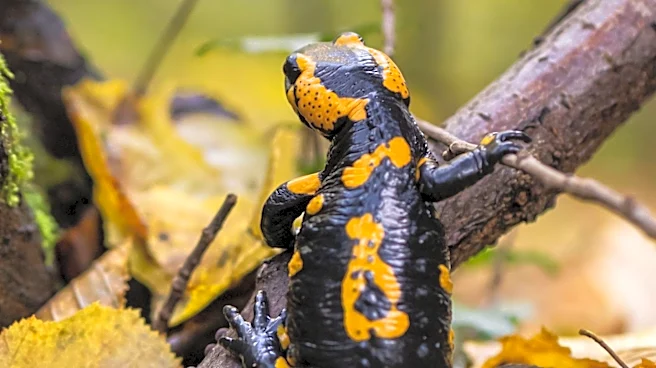










The fire salamander (Salamandra salamandra) is a prominent and common species of salamander found across much of southern and central Europe. Recognized by its striking black body adorned with yellow spots or stripes, this amphibian can also display shades of red and orange, which vary by subspecies. This vivid coloration serves as a crucial warning to potential predators, signaling its toxicity through a phenomenon known as aposematism. Beyond its distinctive
appearance, the fire salamander is notable for its relatively large size among European salamanders, capable of growing between 15 and 25 centimeters long, and for its impressive longevity, with one individual recorded living over 50 years in a German natural history museum.
Habitat and Behavior in the Wild
Fire salamanders primarily inhabit the forests of central Europe, showing a preference for hilly regions. Deciduous forests are particularly favored, as these environments provide ample fallen leaves and mossy tree trunks where the salamanders can hide. A critical component of their habitat is the presence of small brooks or ponds with clean water, which are essential for the development of their larvae. These amphibians are generally inconspicuous, spending a significant portion of their time concealed under wood or other objects within their forest homes.
Their activity patterns are largely nocturnal, meaning they are most active during the evening and night. However, on rainy days, fire salamanders can also be observed moving about during daylight hours. They are typically found at altitudes ranging from 250 to 1,000 meters, though they can occasionally be found as low as 25 meters in northern Germany or at higher altitudes in areas like the Balkans or Spain. This adaptability to varying elevations highlights their widespread distribution across the European continent.
Diet and Feeding Mechanisms
The diet of the fire salamander is diverse, consisting mainly of various invertebrates. Their natural prey includes insects, spiders, millipedes, centipedes, earthworms, and slugs. Occasionally, they may also consume small newts and young frogs. In controlled environments, such as captivity, their diet is adapted to include readily available food sources like crickets, mealworms, waxworms, and silkworm larvae. This varied diet supports their growth and energy needs, contributing to their robust nature.
When capturing prey, fire salamanders employ specific feeding mechanisms. Small prey items are caught either within the range of their vomerine teeth or by the posterior half of their tongue, to which the prey adheres. This efficient method allows them to secure their meals effectively. An adult fire salamander typically weighs about 40 grams. Compared to other regional salamanders, such as Luschan's salamander, the fire salamander is not only larger but also possesses a more solid and longer pectoral girdle, indicating a more robust physical structure.
Threats and Conservation Concerns
Despite being a common species, the fire salamander faces significant threats, particularly from the spread of the chytrid fungus Batrachochytrium salamandrivorans. This introduced fungus has had catastrophic effects on fire salamander populations in certain parts of its range. The collapse of populations was first identified in the Netherlands in 2013, where the species is now on the brink of extinction, confined to just three small populations in the southern part of the country.
Prior to these severe declines caused by the fungus, fire salamanders in the Netherlands were already listed as "Endangered" on the national Red List. Their range had shrunk by 57% since 1950, primarily due to changes in water availability and general habitat degradation. The remaining populations were restricted to specific areas within deciduous forests on hillsides, and their surface activity became limited to humid periods at night. The ongoing threat from the chytrid fungus underscores the urgent need for conservation efforts to protect this distinctive European amphibian from further population loss.