






Sputnik 1, the world's first artificial Earth satellite, launched by the Soviet Union on October 4, 1957, was a testament to innovative engineering despite its apparent simplicity. Its design was driven by specific objectives: to be simple and reliable for future adaptability, to allow for atmospheric density determination from its orbit, to facilitate tracking and gather data on radio wave propagation, and to verify its internal pressurization. These
guidelines shaped a compact yet effective spacecraft that made history and paved the way for subsequent space exploration. The chief constructor of Sputnik 1 at OKB-1 was Mikhail S. Khomyakov, who oversaw its development.
Spherical Design and Structural Integrity
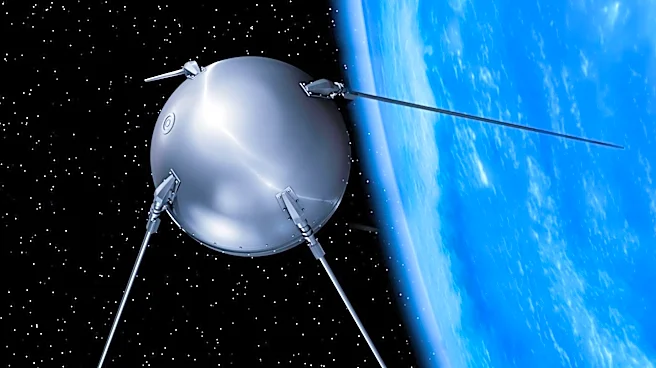
The satellite's most recognizable feature was its spherical shape, a 585-millimeter (23.0 in) diameter sphere. This form was not merely aesthetic; it was chosen to aid in determining atmospheric density based on the satellite's orbital decay. The sphere was meticulously assembled from two hemispheres, which were hermetically sealed using O-rings and secured together by 36 bolts, ensuring a robust and airtight structure. The hemispheres themselves were 2 mm thick, providing a sturdy shell for the internal components. To protect the satellite from the harsh conditions of space and re-entry, it was covered with a highly polished 1 mm-thick heat shield. This shield was crafted from AMG6T, an aluminum–magnesium–titanium alloy, chosen for its protective properties. The total mass of this pioneering satellite was 83.6 kilograms (184 lb).
Communication and Power Systems
Central to Sputnik 1's mission was its ability to communicate with Earth. It carried two pairs of whip-like antennas, designed by the Antenna Laboratory of OKB-1 under Mikhail V. Krayushkin. These antennas, measuring 2.4 and 2.9 meters (7.9 and 9.5 ft) in length, were arranged to provide an almost spherical radiation pattern, ensuring its radio signals could be widely received. Inside the satellite was a one-watt, 3.5 kg radio transmitting unit, developed by Vyacheslav I. Lappo from NII-885, the Moscow Electronics Research Institute. This unit operated on two distinct frequencies: 20.005 MHz and 40.002 MHz. Signals on the first frequency were transmitted in 0.3-second pulses, with pauses of the same duration filled by pulses on the second frequency. This dual-frequency transmission allowed for the analysis of the ionosphere's electron density.
The power supply, a significant component weighing 51 kg, was uniquely shaped like an octagonal nut, with the radio transmitter nestled within its central hole. It consisted of three silver-zinc batteries, developed at the All-Union Research Institute of Power Sources (VNIIT) under Nikolai S. Lidorenko. Two of these batteries were dedicated to powering the radio transmitter, while the third was allocated to the temperature regulation system. Although the batteries had an expected lifetime of two weeks, they remarkably operated for 22 days, providing continuous power for Sputnik 1's transmissions. The power supply was designed to activate automatically the moment the satellite separated from the second stage of its launch rocket.
Internal Environment Control and Protection
Maintaining a stable internal environment was crucial for Sputnik 1's operation. The satellite incorporated a temperature regulation system that included a fan, a dual thermal switch, and a control thermal switch. If the internal temperature exceeded 36 °C (97 °F), the fan would activate. Conversely, when the temperature dropped below 20 °C (68 °F), the dual thermal switch would turn the fan off. More critical temperature deviations, specifically if the temperature surpassed 50 °C (122 °F) or fell below 0 °C (32 °F), would trigger another control thermal switch, which in turn would alter the duration of the radio signal pulses, providing an indication of these conditions to ground control. Sputnik 1 was filled with dry nitrogen, pressurized to 1.3 atm (130 kPa). A barometric switch was also included, designed to activate if the internal pressure dropped below 130 kPa. Such a pressure drop would signal a failure of the pressure vessel or a puncture by a meteor, and like the temperature extremes, it would change the duration of the radio signal impulse. During its ascent, Sputnik 1 was protected by a cone-shaped payload fairing, measuring 80 cm (31.5 in) in height. This fairing separated from both the satellite and the spent R-7 second stage simultaneously as Sputnik 1 was ejected into orbit. All these intricate systems and components underwent rigorous testing at OKB-1, under the leadership of Oleg G. Ivanovsky, to ensure their functionality and reliability in the pioneering mission.