

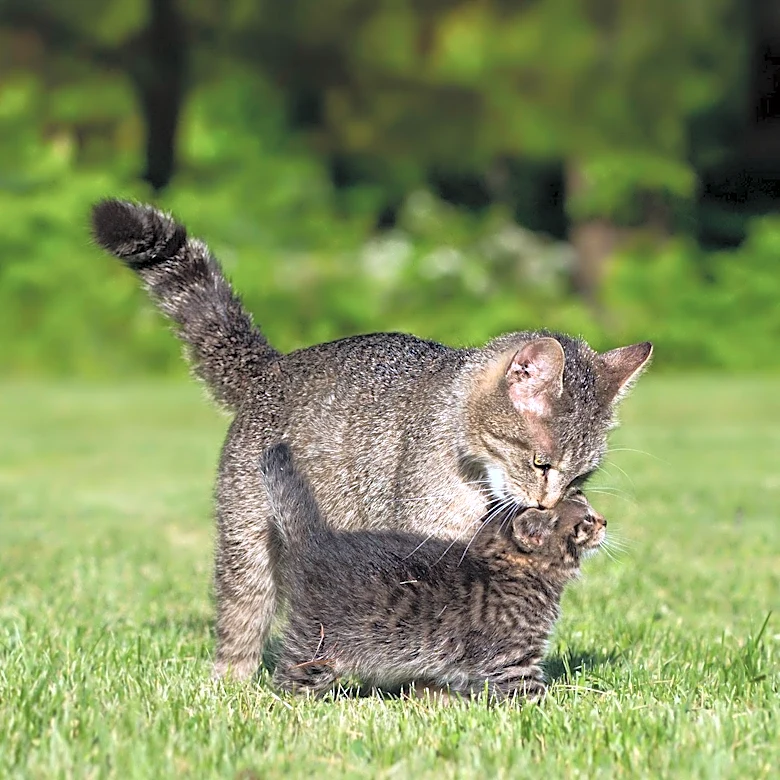






The domestic cat, scientifically known as *Felis catus* or *Felis silvestris catus*, is a small, furry, domesticated, and carnivorous mammal. Often referred to as house cats when kept indoors or simply cats when not needing to be distinguished from other felines, these animals are widely valued by humans for companionship and their hunting prowess against vermin. Their journey from wild ancestors to beloved household pets spans thousands of years,
marked by significant evolutionary and behavioral adaptations.
Origins and Domestication
Cats were once commonly believed to have been domesticated in ancient Egypt, where they were venerated. However, evidence suggests instances of domestication may have occurred as early as the Neolithic period, approximately 9,500 years ago (7,500 BC). A genetic study conducted in 2007 concluded that domestic cats are descended from African wildcats (*Felis silvestris lybica*), with their divergence occurring around 8,000 BC in West Asia. This indicates a long and complex history of interaction between humans and these adaptable felines.
Unlike dogs, which show clear evidence of extensive behavioral modification over tens of thousands of years of deliberate selection, domestic cats have retained many behavioral traits of their wild progenitors. Random-bred cat populations can quickly revert to wild behaviors when isolated from human contact, and individual cats can survive and reproduce without human assistance. This has led some researchers to describe the domestic cat as only "semi-domesticated," occupying an intermediate position between wild and fully domesticated animals.
Biological Classification and Physical Traits
The domestic cat belongs to the kingdom Animalia, phylum Chordata, class Mammalia, order Carnivora, family Felidae, and genus *Felis*. They are the only domesticated species within the Felidae family. Cats share anatomical similarities with other felids, possessing strong, flexible bodies, quick reflexes, sharp retractable claws, and teeth adapted for killing small prey. Their senses are particularly suited to a crepuscular and predatory ecological niche.
Cats have a smaller skull and shorter bones compared to the European wildcat. An adult domestic cat typically measures about 18 inches in head-to-body length and 9.1–9.8 inches in height, with tails around 12 inches long. Males are generally larger than females, and adult domestic cats usually weigh between 8.8–11.0 pounds. Their physical attributes, from their keen senses to their agile bodies, are finely tuned for their role as efficient hunters.
Sensory Adaptations for Predation
Cats possess remarkable sensory capabilities. They can hear sounds that are too faint or too high in frequency for human ears, such as those made by mice and other small animals. Their hearing range is exceptionally broad, from 55 Hz to 79 kHz, allowing them to detect ultrasound. This sensitivity is enhanced by their large, movable outer ears, known as pinnae, which amplify sounds and help pinpoint their origin. Cats also have excellent night vision, capable of seeing at one-sixth the light level required for human vision, thanks to a reflective layer in their eyes called the tapetum lucidum. While their color vision is poorer than humans, optimized for blue and yellowish-green, their ability to see in near darkness is a significant advantage for hunting.