




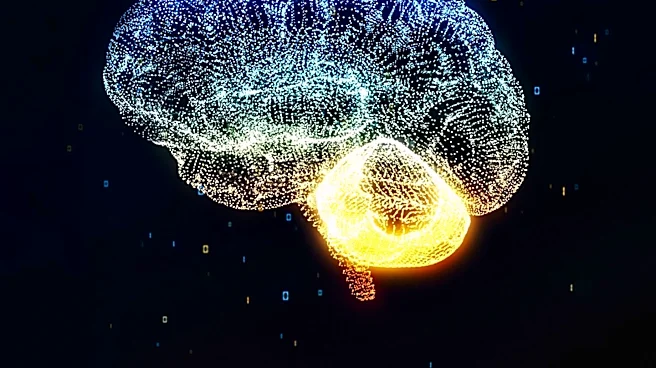
Predictive coding, also known as predictive processing, is a theory of brain function that suggests the brain is constantly building and refining a "mental model" of its surroundings. This internal model isn't just a passive representation; it's actively used to anticipate the sensory information the brain expects to receive. When actual sensory input arrives, it's compared against these predictions. Any discrepancy, known as a prediction error, then
serves as a signal to update and improve the mental model, making future predictions more accurate. This dynamic process is central to how we perceive, learn, and interact with the world.
The Core Mechanism: Prediction and Error Minimization
At its heart, predictive coding proposes a continuous loop of prediction and error correction. The brain's internal model generates top-down predictions about incoming sensory signals across various domains, including visual, auditory, somatosensory, and even internal bodily sensations (interoception). These predictions are then sent down the cortical hierarchy to lower levels of processing. Simultaneously, actual sensory input travels up the hierarchy from the senses.
When the predicted sensory input matches the actual input, the internal model is confirmed, and little to no signal needs to be propagated further up the brain. However, if there's a mismatch—a prediction error—this error signal is sent back up the hierarchy. This ascending error signal is crucial because it indicates that the current mental model is insufficient and needs adjustment. The brain then uses this error to refine its internal representations, aiming to minimize future prediction errors. This process is akin to a continuous learning mechanism, where the brain constantly adapts its understanding of the environment based on new experiences.
Historical Roots and Computational Parallels
The foundational ideas behind predictive coding have a rich history, with theoretical ancestors dating back to the 19th century. Hermann von Helmholtz's concept of "unconscious inference" in 1860 is often cited as an early precursor. Helmholtz suggested that the brain actively "fills in" visual information to make sense of a scene, using prior knowledge to interpret ambiguous sensory data. For example, perceiving depth based on relative object size is an unconscious inference.
Later, in the 1940s, Jerome Bruner's "New Look" psychology explored how needs, motivations, and expectations influence perception, further solidifying the idea of top-down influences on sensory processing. In the late 1990s, Rao and Ballard translated these ideas into a computational model of vision, demonstrating how a generative model could predict visual input and use error signals to update its predictions. This computational framework showed how predictive coding could replicate established receptive field effects in the visual cortex. The theory also draws parallels with Bayesian brain hypotheses and computational schemes like Kalman filtering, which also focus on minimizing prediction error through continuous updates based on new evidence.
The Brain's Efficiency and Active Inference
One of the key advantages of predictive coding is its proposed efficiency. Instead of processing every piece of raw sensory data from the bottom up, the brain primarily focuses on prediction errors. If the internal model accurately predicts sensory signals, activity at higher levels effectively cancels out activity at lower levels, and the model remains stable. This means that only unexpected or novel information, which generates significant prediction errors, needs to be actively processed and propagated up the cortical hierarchy. This inversion of the conventional view of perception—from a mostly bottom-up process to one largely constrained by prior predictions—suggests a highly efficient system.
Furthermore, predictive coding extends beyond mere perception to encompass action through the concept of "active inference." In this view, motor actions are not simply commands but rather descending proprioceptive predictions. The brain actively samples sensory input in ways that help fulfill these predictions, thereby minimizing proprioceptive prediction errors. This perspective suggests that perceptual and motor systems are not separate but rather form a single "active inference machine" that strives to predict its sensory input across all domains, including visual, auditory, somatosensory, interoceptive, and proprioceptive.