


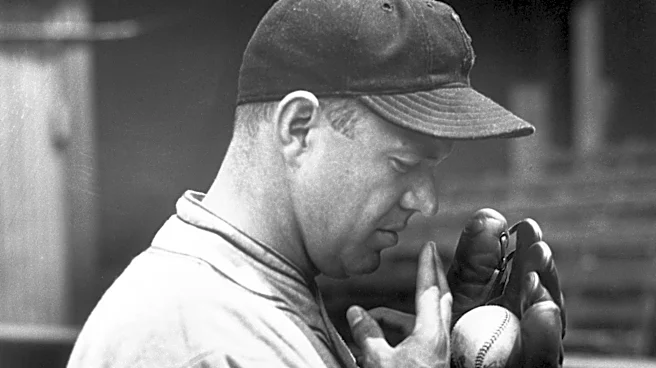

Walter Perry Johnson, famously nicknamed "Barney" and "the Big Train," was a professional baseball player and manager whose entire 21-year Major League Baseball (MLB) career was spent as a right-handed pitcher for the Washington Senators from 1907 to 1927. Renowned as the premier power pitcher of his era, Johnson's impact on the game was immediate and profound. His unique pitching style and overwhelming fastball left an indelible mark on opponents
and set numerous records that stood for decades, solidifying his legacy as one of baseball's all-time greats.
The Unhittable Fastball and Unique Delivery
Ty Cobb, a legendary batter, vividly recalled his first encounter with the rookie Johnson on August 2, 1907. Cobb described seeing "the most threatening sight I ever saw in the ball field," noting that Johnson's pitch "hissed with danger" and was untouchable. This powerful fastball was the cornerstone of Johnson's success. In 1917, a munitions laboratory in Bridgeport, Connecticut, recorded Johnson's fastball at 134 feet per second, which translates to 91 miles per hour. This velocity was likely unmatched in his time, with the possible exception of Smoky Joe Wood.
What made Johnson's delivery even more remarkable was his sidearm motion, a stark contrast to the straight overhand delivery typically associated with power pitchers. This sidearm approach made the ball appear to right-handed batters as if it were coming from third base, adding to its deceptive nature. His pitching mechanics were described as superb, characterized by powerful shoulder rotation and excellent balance. While primarily known for his fastball, Johnson also developed an occasional curveball around 1913 or 1914, further diversifying his arsenal.
Record-Setting Strikeouts and Wins
Johnson's overpowering fastball was the main reason for his exceptional statistics, particularly his fabled strikeout totals. He amassed a record 3,508 strikeouts, a mark that stood for over 55 years until it was surpassed by Nolan Ryan, Steve Carlton, and Gaylord Perry in 1983. As of 2026, Johnson ranks eleventh on the all-time strikeout list. However, this total must be viewed within the context of his era, which saw significantly fewer strikeouts overall. Among his contemporaries before World War II, only Cy Young (2,803) and Tim Keefe (2,562) came within 1,000 strikeouts of Johnson's total.
Beyond strikeouts, Johnson's win-loss record is equally impressive. As a right-handed pitcher for the Washington Senators, he won 417 games, placing him second only to Cy Young, who had 511 wins. Johnson and Young remain the only two pitchers in history to have won 400 or more games. Over his 21-year career, Johnson achieved twelve 20-win seasons, including an astonishing ten in a row. He twice surpassed 30 wins, with 33 in 1912 and 36 in 1913. His record also includes 110 shutouts, the most in baseball history. He held a 38-26 record in games decided by a 1-0 score, setting major league records for both wins and losses in such tight contests. Notably, Johnson also lost 65 games because his teams failed to score a single run. In a remarkable display of dominance, he shut out the New York Highlanders in three consecutive games on September 4, 5, and 7, 1908.
Triple Crowns, MVP Awards, and Enduring Legacy
Johnson's individual accolades include winning the pitching Triple Crown three times (1913, 1918, and 1924), leading the league in wins, strikeouts, and earned run average in those seasons. He also earned the American League Most Valuable Player Award twice, in 1913 and 1924, a feat only two other pitchers, Carl Hubbell and Hal Newhouser, have matched. His earned run average (ERA) of 1.14 in 1913 was the fourth-lowest ever at the time and remains the sixth-lowest today, despite being surpassed by Bob Gibson's 1.12 in 1968 for pitchers with over 300 innings. This ERA could have been even lower if not for a peculiar tradition of manager Clark Griffith, who often treated fans to a "farce game" on the last day of the season. In one such game, Johnson played center field before pitching, allowing two runs that were later charged to him, raising his ERA from 1.09 to 1.14. For the decade between 1910 and 1919, Johnson averaged 26 wins per season with an overall ERA of 1.59.
In 1913, Johnson won 36 games, accounting for 40% of his team's total wins that season. He also pitched 55 and 2/3 consecutive scoreless innings in April and May, a record that stood for 55 years and remains the American League's best and the third-longest streak in history. In May 1918, he pitched another 40 consecutive scoreless innings, making him the only pitcher with two such streaks of 40 or more innings. Despite often playing for losing teams, Johnson finally led the Washington Senators to the World Series in 1924, his 18th year in the league. Although he lost the first and fifth games, he became the hero by pitching four scoreless innings of relief in the seventh and deciding game, securing the win in the 12th inning. The Senators returned to the World Series the following season, where Johnson had two early wins but ultimately lost in Game 7. On October 15, 1927, Johnson was granted an unconditional release from the club, concluding a legendary playing career.