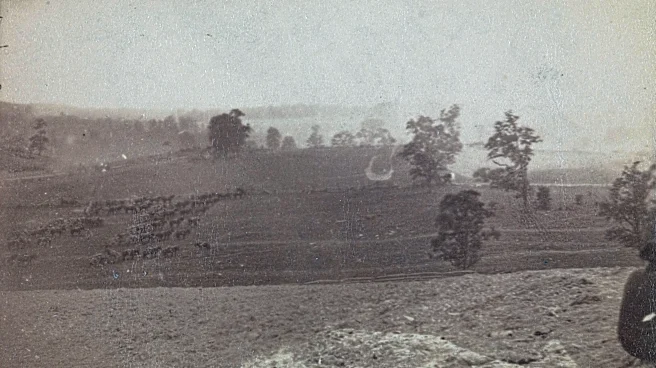

The Battle of Cane Hill, fought on November 28, 1862, in Washington County, Arkansas, was a significant engagement during the American Civil War. This nine-hour conflict, which stretched over 12 to 15
miles of rugged terrain, was characterized by its dynamic, running nature rather than a static confrontation. It involved Union forces under Brigadier General James G. Blunt and Confederate troops led by Brigadier General John S. Marmaduke. The battle was part of a larger Confederate strategy to disrupt Union operations in northwestern Arkansas, and its inconclusive outcome, despite light casualties, highlighted the logistical and tactical complexities of warfare in the Ozark Mountains.
Prelude to Conflict: Maneuvering and Misinformation
Confederate Major General Thomas C. Hindman, having previously withdrawn from an offensive into southwestern Missouri, saw an opportunity to strike at Blunt's isolated Union division in northwestern Arkansas. His plan was to use a cavalry force to distract Blunt, then isolate and defeat his command before Union reinforcements from Springfield, Missouri, could arrive. Brigadier General John S. Marmaduke was tasked with leading this cavalry force, moving north towards Cane Hill with approximately 2,000 men and six cannons to gather supplies from the local populace.
Union intelligence, however, overestimated Marmaduke's strength, believing he commanded 5,000 men, and later even over 8,000. This misinformation led Blunt to adopt a defensive posture and inform his superiors, causing a planned Union movement to be canceled. Feeling abandoned by his command and determined to halt Confederate supply-gathering, Blunt decided to go on the offensive. He believed an attack offered the best chance of success, especially after a previous incident where he had taken a defensive position against an anticipated Confederate assault that never materialized. Blunt's advance was delayed by two days as he awaited supply wagons, underscoring the logistical difficulties inherent in the Ozark Mountains, which heavily influenced military operations in the region. While Union forces had ample ammunition and superior artillery, many Confederate cannons were obsolescent, and their cavalry's horses were in poorer condition, with soldiers often inadequately uniformed.
The Opening Skirmishes and Artillery Duels
Blunt's force, numbering 5,000 men, departed on November 27 and reached Rhea's Mill, about 7 miles from Cane Hill, the following morning. Marmaduke, who had been planning an attack on Elkhorn Tavern, learned of Blunt's advance up the Line Road and canceled his own movement. He ordered his supply wagons to safety and prepared for a delaying action. Anticipating Blunt would use the direct Cincinnati Road, Confederates positioned themselves to defend it. However, Blunt approached via the Ridge Road, which intersected the Fayetteville Road before leading to Cane Hill, resulting in the Confederates facing northwest while Blunt arrived from the northeast. Colonel Joseph O. Shelby's patrols guarded the Fayetteville Road, with two guns from Joseph Bledsoe's Missouri Battery strategically placed.
At approximately 5:00 AM on November 28, Blunt's advance continued. Colonel William F. Cloud, leading the column, sent the 2nd Kansas Cavalry Regiment and an associated artillery battery forward. About half a mile from the Confederate position, they encountered Shelby's scouts, who retreated after a brief exchange of fire. The Union pursuit led them to a hill where Bledsoe's battery was deployed. An artillery duel commenced around 10:00 AM, with both sides bringing up additional cannons. Bledsoe repositioned a second gun, and two cannons from Shoup's Arkansas Battery advanced, while six cannons from the 2nd Indiana Battery deployed for the Union. This exchange lasted about an hour with minimal effect. Shelby, realizing the Union was not using the Cincinnati Road, began to withdraw. Blunt, finding his lead force isolated, sent an aide to hasten the rest of his command, which had been delayed by an infantry unit in the marching column. Once the full brigade arrived, Cloud deployed his men, and Shelby ordered a retreat, with fighting moving through Cane Hill town, damaging Cane Hill College.
The Running Fight and Reed's Mountain
Beyond Cane Hill, Colonel Charles A. Carroll's Confederate brigade, with about 400 men and two mountain howitzers, attempted to slow the Union advance at Kidd's Mill. Despite some of Carroll's men being armed only with shotguns, they fired a few volleys before withdrawing, with Shelby's men providing a rearguard. By noon, the fighting had shifted half a mile south towards Newburg, where Marmaduke formed what Blunt considered a strong defensive line. Blunt reorganized his forces, bringing up Colonel William Weer's brigade, and Union artillery, including six Parrott rifles and the 2nd Indiana Battery, opened fire. Bledsoe's battery and Carroll's howitzers returned fire around 1:00 PM, but the Confederates soon withdrew down the Van Buren Road, partly due to their less effective artillery. The engagement then transformed into a running fight.
As the Confederates retreated towards Reed's Mountain, located a mile south of Newburg and about 400 feet higher than the surrounding terrain, Shelby employed "brilliant" defensive tactics. He aligned his men in a series of lines, firing and then retreating, forcing Union troops to encounter successive prepared positions. Around 2:00 PM, Marmaduke decided to make a stand at Reed's Mountain, deploying Shelby and Colonel Emmett MacDonald in a forward line, with Carroll's men further up the mountain. This decision was likely to protect the retreating wagons or to create an opportunity for Hindman's main force to attack Blunt. Blunt, personally leading the Union advance, attacked the Reed's Mountain position with elements of the 2nd Kansas Cavalry, 3rd Indian Home Guard, and 11th Kansas Infantry. The 6th Kansas Cavalry also participated. Fighting became intense, at times hand-to-hand, and MacDonald's men even launched a small counterattack. After about an hour and a half, visibility severely decreased due to smoke from brush fires. Union artillery, including four mountain howitzers, fired at close range, forcing Bledsoe's guns to withdraw due to lack of ammunition, and another Confederate cannon was damaged. With his cavalry also low on ammunition, Marmaduke ordered a withdrawal. Shelby's men, retreating, taunted Carroll's men for their minimal role, prompting Carroll to order a final volley before withdrawing.
The Ambush and Aftermath
Around 5:00 PM, the Union pursuit reached John Morrow's house, where the Confederate retreat turned south. Carroll's men began to panic, and the retreat became disorganized. Two to four miles south of the Morrow house, the Confederates set a trap in a wider hollow, aligning men from Shelby's command and Monroe's Arkansas Cavalry Regiment. Blunt, aggressively pushing ahead with a small force from the 6th Kansas Cavalry, hoping to capture Confederate cannons, rode into the ambush. The Confederate cavalry opened fire, throwing the Union troops into confusion. Carroll ordered 85 men under Monroe to attack, allowing the rest of his force to retire. Cloud arrived with artillery batteries and parts of the 3rd Indian Home Guard and 11th Kansas Infantry. Accounts differ on whether a flag of truce was presented, but many Union sources and historians suggest Confederates used a flag of truce as a ruse to break contact and escape while aid was provided to wounded soldiers. The fighting, which had lasted about nine hours and covered 12 to 15 miles, concluded with the Confederates successfully disengaging. The Battle of Cane Hill was ultimately inconclusive, with light casualties on both sides, but it set the stage for further engagements in the region.