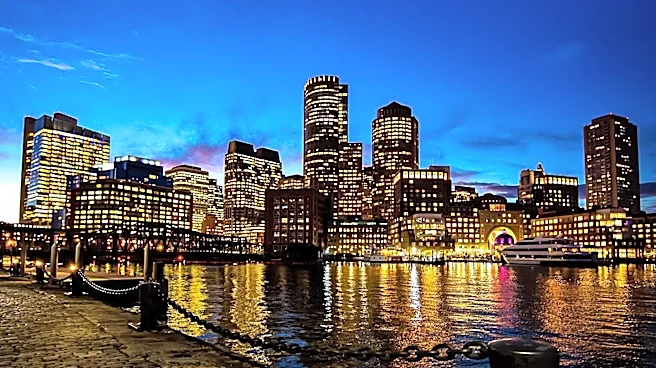

Boston, the capital and largest city in Massachusetts, has undergone a profound urban evolution since its founding in 1630. Established by Puritan settlers from England, the city's initial footprint was
modest, but through centuries of deliberate expansion and adaptation, it has transformed into a sprawling metropolis. This journey involved not only significant geographical changes, such as extensive land reclamation, but also economic shifts and ambitious urban renewal projects designed to address the challenges of growth and decline. The city's development reflects a continuous effort to reshape its environment and economy to meet the demands of changing times.
Geographical Expansion Through Land Reclamation
One of the most remarkable aspects of Boston's urban development is its physical expansion through land reclamation. Between 1631 and 1890, the city's area dramatically tripled as marshes, mud flats, and the spaces between wharves along the waterfront were systematically filled in. This process was not merely incidental; it was a deliberate strategy to create more usable land for a growing population and expanding economy.
Mid-19th-century reclamation projects were particularly impactful, giving rise to significant portions of what are now well-known neighborhoods and districts. Areas such as the South End, the West End, the Financial District, and Chinatown owe much of their existence to these ambitious engineering feats. This continuous reshaping of the land allowed Boston to accommodate its increasing population and industrial needs, fundamentally altering its coastline and internal geography.
Economic Transformations and Periods of Decline
Boston's economic trajectory has been dynamic, marked by periods of prosperity and challenge. In its early colonial days, its oceanfront location made it a thriving port, engaging in shipping and fishing and serving as a key stop on the Caribbean trade route. This maritime activity made Boston the largest town in the Thirteen Colonies until the mid-18th century, when it was surpassed in wealth by New York City and Philadelphia.
The decades leading up to the American Revolution saw Boston's economy stagnate, even as other New England cities grew rapidly. After the Revolution, its seafaring tradition helped it regain prominence as one of the nation's busiest ports. However, the Embargo Act of 1807 and the War of 1812 curtailed foreign trade, prompting merchants to invest in manufacturing. By the mid-19th century, manufacturing became the dominant economic force, supported by the region's rivers and a growing railroad network. By the early to mid-20th century, Boston again faced economic decline as its factories became obsolete and businesses moved elsewhere. This period necessitated a new phase of urban adaptation.
Urban Renewal and Community Development
In response to economic decline in the mid-20th century, Boston embarked on various urban renewal projects under the direction of the Boston Redevelopment Authority (BRA), established in 1957. These initiatives aimed to modernize the city and stimulate growth. One notable project in 1958 involved improving the historic West End neighborhood, but it was met with strong public opposition due to extensive demolition and the displacement of thousands of families. This controversial effort highlighted the social complexities of large-scale urban planning.
Despite such challenges, renewal efforts continued. The clearance of the vibrant Scollay Square area for the construction of the modernist Government Center exemplifies another significant transformation. In a different vein, the Columbia Point Health Center opened in the Dorchester neighborhood in 1965, becoming the first Community Health Center in the United States. It primarily served the large Columbia Point public housing complex, built in 1953. This health center, rededicated in 1990 as the Geiger-Gibson Community Health Center, remains operational. Furthermore, the Columbia Point complex itself underwent a major redevelopment and revitalization from 1984 to 1990, transforming into the mixed-income Harbor Point Apartments, showcasing ongoing efforts to adapt and improve urban living spaces.