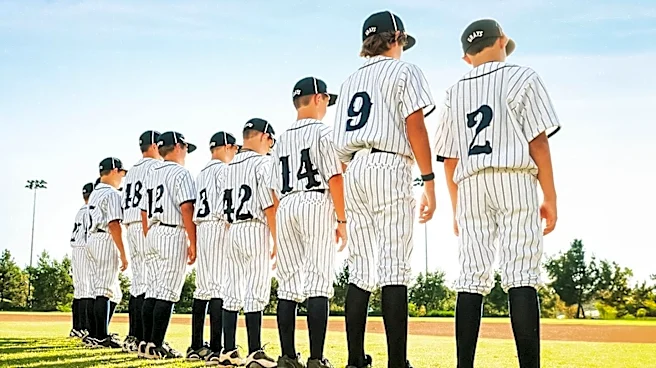







Little League Baseball, a 501(c)(3) nonprofit organization based in South Williamsport, Pennsylvania, has grown from a local pastime into an international phenomenon. Its origins trace back to 1939, when the first league game was played on June 6. This inaugural match saw Lundy Lumber defeat Lycoming Dairy with a score of 23-8. Lycoming Dairy, however, went on to become the champions of the first half of the season and subsequently triumphed over
Lundy Lumber, the second-half champions, in a best-of-three championship series. The following year, a second league was established in Williamsport, marking the initial steps of an organization that would eventually encompass nearly 200,000 teams across every U.S. state and more than 80 countries.
Early Growth and National Recognition
The organization's growth was steady in its early years. By 1946, Little League had expanded to include twelve leagues within Pennsylvania. A significant milestone occurred in 1947 with the founding of the first league outside of Pennsylvania, located in Hammonton, New Jersey. That same year, the Maynard League of Williamsport secured victory in the first Little League World Series, defeating a team from Lock Haven, Pennsylvania. The growing prominence of Little League was further highlighted in 1949 when it was featured in the nationally renowned weekly magazine, the Saturday Evening Post, and in newsreels shown in neighborhood movie theaters. This national exposure led to hundreds of requests for information on forming local leagues from across the country, prompting Little League to incorporate in the State of New York. By 1954, the organization boasted over 3,300 affiliated leagues throughout the United States.
The International Era and Key Innovations
The international expansion of Little League began in 1951 with the establishment of the first league in Canada. The organization truly entered its international phase in 1957, a year marked by the victory of the young Mexican team from Monterrey in the Little League World Series, a triumph famously portrayed in the 2010 film "The Perfect Game." This period also saw the Little League World Series relocate from Williamsport to the newly constructed Little League headquarters in South Williamsport in 1959. That same year, Dr. Creighton J. Hale developed the protective baseball helmet, a crucial safety innovation. By 1960, Little League had grown to include 27,400 teams in over 5,500 leagues, and the World Series was broadcast live on ABC for the first time, with a team from West Berlin, West Germany, becoming the first European team to participate.
Further innovations and milestones continued through the decades. In 1971, the aluminum baseball bat, partly developed by Little League Baseball, was introduced. This era also saw significant changes regarding participation. In 1974, girls were formally permitted to play in Little League as a result of a lawsuit, and a Little League Softball program was created for both boys and girls. Bunny Taylor made history that year by becoming the first girl to pitch a no-hitter. The organization faced a controversial decision in 1975 when all foreign teams were temporarily banned from the Little League World Series, though international play was reinstated the following year. By the 1980s, Little League comprised over 14,000 leagues, 145,000 teams, and 2.25 million players across 30 countries.
Modern Expansion and Notable Moments
The turn of the millennium brought further expansion and notable events. In 2000, an expansion project at Little League International led to the construction of Volunteer Stadium, which allowed the number of participants in the World Series to double from 8 to 16 teams the following year. This expansion also led to significant changes in regional lineups, both within the U.S. and internationally, creating new regions like New England, Mid-Atlantic, Great Lakes, Midwest, Southeast, Southwest, Northwest, Caribbean, Mexico, Asia, Pacific, and TransAtlantic. In 2001, George W. Bush became the first U.S. president to visit the Little League World Series. The Intermediate (50/70) Division, which had operated on a pilot basis since 2011, was announced as an official Little League division in 2012, marking the first new division since 1999. This division features a larger field and rules closer to standard baseball. In 2013, Davie Jane Gilmour became the first woman to lead the Little League board of directors, and the first Intermediate Little League World Series was held. The organization continues to evolve, with the World Series tournament size increasing from 16 to 20 teams in 2022, adding new regions and direct qualifiers.