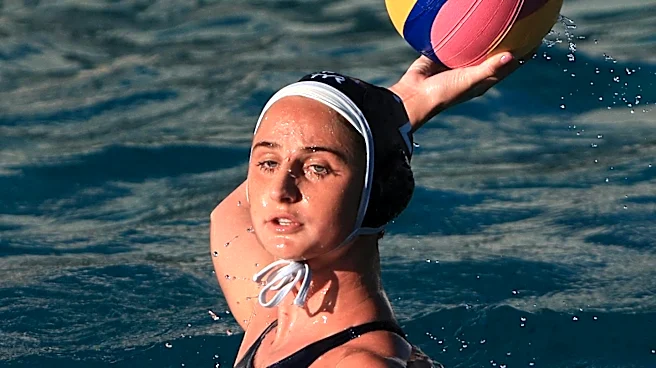

The women's water polo tournament at the 2016 Summer Olympics in Rio de Janeiro, Brazil, was a meticulously organized event, bringing together the world's top teams. Held from August 9 to August 19, 2016, the competition unfolded across two venues: the Maria Lenk Aquatics Centre and the Olympic Aquatics Stadium. Understanding the qualification pathways and the structure of the tournament provides insight into the journey these athletes undertook to compete
on the Olympic stage.
Navigating the Qualification Gauntlet
Securing a spot in the Olympic women's water polo tournament was a multi-stage process, with berths allocated through various continental championships and a final World Qualification Tournament. Brazil, as the host nation, automatically received one berth. The Oceanian Continental Selection, held in Perth, Australia, in October 2015, granted Australia a spot. The 2015 Asian Championship in Foshan, China, in December 2015, saw China qualify. Hungary earned its place through the 2016 European Championships in Belgrade, Serbia, in January 2016.
The remaining four berths were fiercely contested at the World Qualification Tournament, which took place from March 21 to March 28, 2016, in Gouda, Netherlands. This crucial event saw the United States, Italy, Russia, and Spain emerge victorious, completing the roster of eight teams for the Olympic tournament. This diverse qualification system ensured that the most competitive teams from around the globe had the opportunity to participate in the Games.
Tournament Structure and Group Dynamics
The tournament itself was divided into two main stages: a group stage followed by a knockout stage. The eight qualified teams were seeded into two groups for the preliminary round, with the draw held on April 10, 2016. Group A comprised Italy, Australia, Russia, and host nation Brazil. Group B featured the United States, Spain, Hungary, and China. In the group stage, teams played every other team in their group once. Two points were awarded for a victory and one for a draw. Notably, all teams from both groups advanced to the quarterfinals, meaning the group stage primarily served to determine seeding for the knockout rounds.
In Group A, Italy finished first with 6 points, followed by Australia with 4, Russia with 2, and Brazil with 0. Italy demonstrated strong performance with a +12 goal difference. In Group B, the United States dominated, also securing 6 points with an impressive +20 goal difference. Spain came in second with 4 points, Hungary third with 2, and China fourth with 0. These group standings set the stage for the intense knockout phase.
Knockout Stage and Overall Statistics
Following the group stage, the competition intensified with the quarter-finals, semi-finals, and medal matches. The bronze medal match saw Russia defeat Hungary in a high-scoring affair, 19–18, after a penalty shootout. The gold medal match featured the United States against Italy, with the U.S. team winning decisively 12–5. The final ranking placed the United States as champions, Italy as runners-up, Russia in third, and Hungary in fourth.
Overall, the tournament consisted of 24 matches, with a total of 435 goals scored, averaging 18.13 goals per match. Individual statistics highlighted key performances, such as Maggie Steffens of the United States as the top scorer with 17 goals, and Giulia Gorlero of Italy leading in saves with 65. The event also recognized multiple Olympians, including Tania Di Mario of Italy as a four-time Olympian, and Kami Craig of the United States as a three-time Olympic medalist, underscoring the enduring careers of these elite athletes.