


The Viking 1 mission was not only a technological triumph but also a scientific endeavor aimed at answering one of humanity's most profound questions: Is there life on Mars? As part of NASA's Viking program, Viking 1 was equipped with a suite of scientific instruments designed to search for biosignatures of microbial life on the Martian surface. This article explores the experiments conducted by Viking 1 and their implications for our understanding
of life beyond Earth.
The Lander's Scientific Instruments
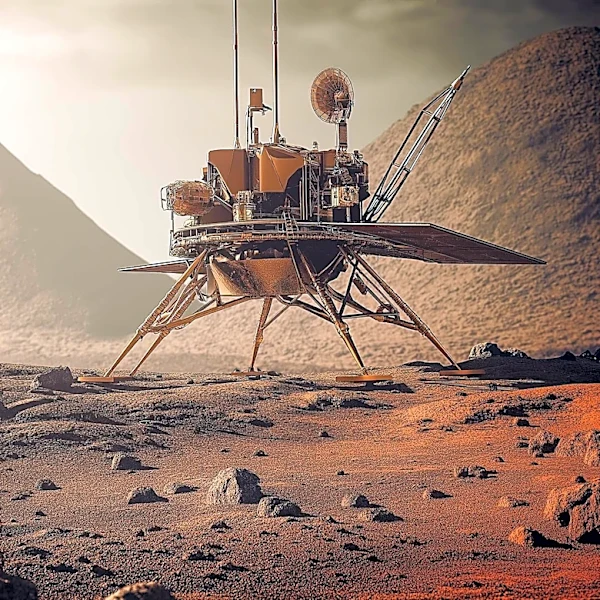
Viking 1 was equipped with a variety of instruments to study the Martian surface and atmosphere. Among these were two facsimile cameras, a gas chromatograph-mass spectrometer, and sensors for measuring pressure, temperature, and wind velocity. The lander also carried a magnet on a sampler observed by the cameras, and a three-axis seismometer.
The primary focus of Viking 1's scientific mission was to detect signs of life. To achieve this, the lander conducted several experiments, including analyses for metabolism, growth, or photosynthesis. These experiments were designed to detect any biological activity in the Martian soil, providing insights into the potential for life on Mars.
The Biological Experiments
One of the key experiments conducted by Viking 1 was the Labeled Release (LR) experiment. This experiment involved inoculating a sample of Martian soil with a nutrient solution tagged with radioactive carbon. The air above the soil was monitored for the evolution of radioactive gas, which would indicate that microorganisms in the soil had metabolized the nutrients.
The LR experiment yielded surprising results, with a steady stream of radioactive gases being released from the soil immediately following the first injection. However, subsequent control tests, which involved heating the soil samples, showed no release of radioactive gas, suggesting that the initial results may have been due to chemical reactions rather than biological activity.
Implications and Legacy
The Viking 1 mission's search for life on Mars was groundbreaking, although the results were inconclusive. The experiments conducted by Viking 1 provided valuable data about the Martian environment, including its soil composition and atmospheric conditions. While the mission did not find definitive evidence of life, it laid the groundwork for future exploration and research.
The legacy of Viking 1 continues to influence Mars exploration today. The mission demonstrated the feasibility of conducting scientific experiments on the Martian surface, inspiring subsequent missions to build upon its findings. As technology advances, the search for life on Mars remains a central focus of planetary exploration, driven by the pioneering efforts of Viking 1.