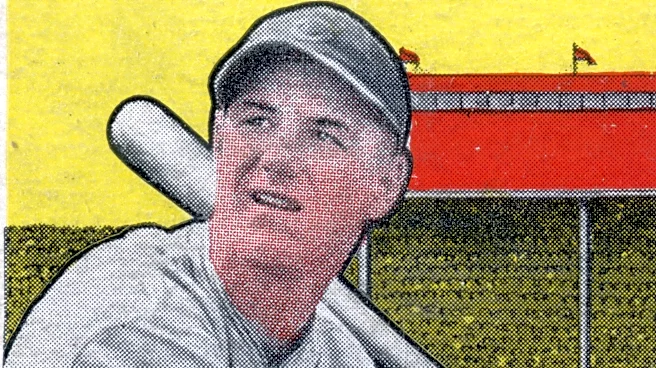




Louis Boudreau, affectionately known by nicknames such as "Old Shufflefoot," "Handsome Lou," and "the Good Kid," left an indelible mark on the world of baseball across multiple decades and roles. Born on July 17, 1917, in Harvey, Illinois, Boudreau's journey through professional baseball spanned 15 seasons as a player, primarily as a shortstop for the Cleveland Indians, and another 15 seasons as a manager for four different teams, including a decade as a player-manager.
His career was not confined to the diamond; he also became a respected radio announcer, further cementing his place in baseball history. Boudreau's multifaceted contributions were ultimately recognized with his induction into the National Baseball Hall of Fame in 1970, a testament to a life dedicated to the sport.
A Collegiate Dual-Sport Star
Boudreau's athletic prowess was evident long before his professional baseball career began. He attended the University of Illinois, where he distinguished himself as a dual-sport athlete. Excelling in both baseball and basketball, Boudreau earned All-American honors in basketball, showcasing a rare versatility that hinted at his future success in professional sports. This early demonstration of athletic talent and leadership laid the groundwork for his eventual rise in Major League Baseball. His collegiate background provided a strong foundation for the discipline and strategic thinking that would define his professional career.
His transition to professional baseball began with his MLB debut on September 9, 1938, with the Cleveland Indians. Even as he embarked on his baseball journey, Boudreau also played professional basketball for Hammond, Indiana, in the National Basketball League, further illustrating his exceptional athletic capabilities. This period of his life highlights a time when multi-sport athletes were more common, and Boudreau stood out as one of the era's most gifted.
A Decorated Playing and Managing Career
Boudreau's 15-season playing career was filled with accolades. As a shortstop, he maintained a career batting average of .295, hit 68 home runs, and drove in 789 runs. He was a seven-time All-Star and led the American League in doubles in 1941, 1944, and 1947. In 1944, he captured the American League batting title with a .327 average. Defensively, he was equally dominant, leading AL shortstops in fielding eight times. He still holds the MLB record for hitting four consecutive doubles in a single game, achieved on July 14, 1946, and recorded the most hits (1,578) of any player in the 1940s.
His managerial career was highlighted by the 1948 season, where he achieved the rare feat of winning the American League Most Valuable Player Award while simultaneously managing the Cleveland Indians to a World Series championship. This remarkable year underscored his unique ability to lead a team to glory while performing at an elite level himself. His overall managerial record stood at 1,162 wins and 1,224 losses, reflecting a challenging but impactful career in the dugout. After his playing career concluded with the Boston Red Sox in 1952, he continued managing the Red Sox, Kansas City Athletics, and Chicago Cubs.
A Voice in the Booth and a Rulebook Expert
Following his extensive playing and managing career, Boudreau transitioned to the broadcast booth, becoming a familiar voice for baseball fans. He served as a play-by-play announcer for Chicago Cubs games from 1958 to 1959, and after a brief return to managing the Cubs in 1960, he resumed his broadcasting role, remaining there until 1987. His broadcasting career also included work for the Chicago Bulls (1966–1968) and Chicago Blackhawks on WGN radio and television, showcasing his versatility beyond baseball.
One notable incident from his broadcasting days occurred on June 23, 1976. During a Cubs game against the Pittsburgh Pirates, umpires called the game due to darkness before it was official, intending to resume it the next day. Boudreau, with his encyclopedic knowledge of baseball rules, quickly informed the umpires that an unofficial game could not be treated as a suspended game and had to be replayed from the start. After consulting the National League office, Boudreau was proven correct, and the Cubs' two-run deficit was erased. This event highlighted his deep understanding of the game's regulations and his enduring impact on baseball, even from the announcer's booth. His number 5 was retired by the Indians in 1970, the same year he entered the Hall of Fame, solidifying his lasting legacy.