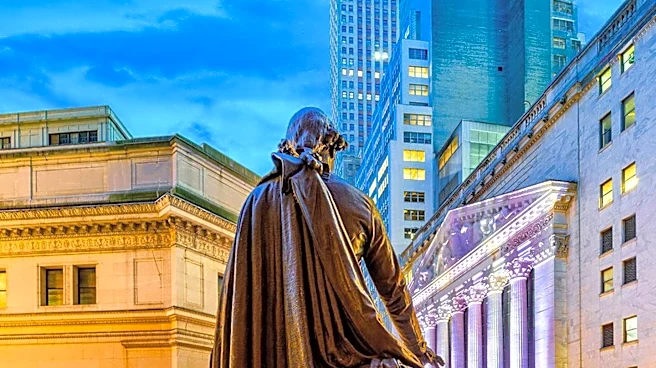




On April 30, 1789, a pivotal moment in American history unfolded in New York City: the first inauguration of George Washington as President of the United States. This event, held at Federal Hall, marked the official start of the American presidency and set a precedent for future transitions of power. The day was filled with ceremony and public anticipation, as citizens gathered to witness their first leader take the oath of office, signifying the birth
of a new national government.
The inauguration was not just a formal procedure; it was a public spectacle that drew large crowds and involved several key figures who played significant roles in the nascent republic. The choice of New York City as the capital for this momentous occasion underscored its importance in the early days of the United States, serving as the center of political activity as the new government found its footing.
The Journey to Federal Hall and Washington's Attire
From nearly first light on April 30, 1789, crowds began to gather around George Washington's residence. By noon, these throngs of people made their way to Federal Hall, traversing Queen Street and Great Dock, both of which are now known as Pearl Street, and continuing along Broad Street. The journey itself was a public procession, with citizens eager to catch a glimpse of their new president.
Washington's appearance for the ceremony was carefully chosen, reflecting a blend of American craftsmanship and dignified simplicity. He was dressed in a dark brown suit, made in America, complemented by white silk stockings and silver shoe buckles. His ensemble also included a steel-hilted sword and a dark red overcoat, presenting a figure of both military bearing and civilian leadership for the historic occasion.
The Oath and Public Acclamation
Upon his arrival at Federal Hall, which served as the nation's capital and the meeting place for the 1st United States Congress, Washington was formally introduced to both the House and Senate. Vice President John Adams, who had already assumed his role on April 21 and begun presiding over Senate sessions, then announced that it was time for the inauguration ceremony to commence. Washington proceeded to the second-floor balcony, where he would take the oath of office.
Chancellor of New York, Robert Livingston, administered the presidential oath. Livingston was a notable figure, having served on the Committee of Five responsible for drafting the Declaration of Independence. As he administered the oath, throngs of people gathered on the streets below watched the historic event. The Bible used for the ceremony came from St. John's Lodge No. 1, with its Master, Jacob Morton, serving as the Marshal of the Inauguration. The Bible was opened at random to Genesis 49:13. Following the oath, Livingston famously shouted, "Long live George Washington, President of the United States!" This declaration was met with enthusiastic cheers from the crowd and a 13-gun salute, symbolizing the thirteen states of the new union.
The First Inaugural Address and Its Impact
After the public oath, Washington delivered his first inaugural address in the Senate chamber. This address, which was 1,419 words long, was a significant moment, even though the Constitution did not explicitly require an inaugural address. Washington felt it was important to speak on this momentous occasion, though the task reportedly caused him considerable distress.
An observer, Maclay, described Washington's demeanor during the address, noting that he appeared agitated and embarrassed, more so than he had ever been in battle. Maclay observed Washington trembling and struggling to read his speech, despite presumably having reviewed it multiple times. He shifted the paper between his hands, and at one point, made a somewhat "ungainly" flourish with his right hand when he spoke the words "all the world." Maclay, wishing for a simpler delivery, noted Washington's attire: deep brown with metal buttons featuring an eagle, white stockings, a bag, and a sword. This detailed account provides a vivid picture of the human element behind the historic formality. While there were no inaugural balls on the day of the ceremony, a ball was held a week later, on May 7, in New York City to honor the newly inaugurated President.