

Utkatasana, widely recognized as Chair Pose in modern yoga practice, is a standing asana that has a rich history and several variations. The name itself, derived from Sanskrit, offers insight into its nature, with "utkaṭa" meaning "wild, frightening, above the usual, intense, gigantic, furious, or heavy," and "āsana" signifying "posture" or "seat." While the chair-like form is a staple in contemporary yoga, its origins trace back to different interpretations
and forms over time, highlighting an interesting evolution within the practice.
Ancient Roots and Modern Interpretations
The earliest known depiction of Utkatasana, or a pose closely resembling it, can be found in the 19th-century text *Sritattvanidhi*. This older version shows a yogin squatting lower down onto the heels, a posture that is quite similar to Upaveshasana. This suggests that the pose initially involved a deeper squat, emphasizing a different physical engagement than its modern counterpart.
In contrast, the modern chair-like pose, which is more commonly practiced today, is attributed to Krishnamacharya. This shift in form indicates a significant development in how the pose was taught and understood, moving towards a posture that mimics sitting in an imaginary chair. This evolution reflects broader changes and adaptations within yoga as it developed into the exercise forms popular in the modern era.
Description of the Modern Chair Pose
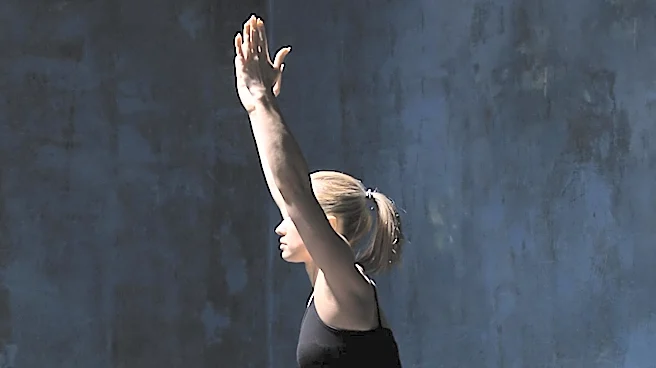
In the contemporary practice of Utkatasana, the pose is characterized by specific alignments. The knees are typically positioned hips-width apart and bent, with the hips pushed back as if one is about to sit down. The chest is inclined forward, and both arms are raised above the head, aligned with the ears. Practitioners are encouraged to elongate the spine and lift the sternum, contributing to the pose's description as powerful and stimulating, often likened to the shape of a lightning bolt.
This modern interpretation emphasizes strength and engagement throughout the body, particularly in the legs and core. The act of bending the knees and lowering the hips while keeping the chest lifted creates a challenging yet invigorating posture. The focus on spinal elongation and sternum lift also highlights the pose's connection to breath and energetic flow within the body, aligning with the stimulating qualities suggested by its Sanskrit name.
Variations of Utkatasana
The core Utkatasana pose has given rise to several variations, each offering a different physical experience and challenge. One such variation is Ardha Utkatasana, where the knees are bent closer to a right angle, bringing the thighs more nearly parallel to the floor. In this variation, the body is inclined further forward, closer to the thighs, intensifying the engagement of the leg muscles.
Another significant variation is Parivritta Utkatasana, known as the rotated variant. In this pose, the hands are pressed together in front of the chest in Anjali Mudra, a prayer-like gesture. The lower elbow is then pressed against the outside of the opposite knee, and the gaze is directed upwards, adding a twisting element to the foundational chair pose. Utkata Konasana, or Goddess Pose, is also related but distinct, featuring legs wide apart, feet turned outwards in line with the thighs, and bent knees. The arms in Goddess Pose are typically raised with bent elbows, though variations include arms straight up or hands held in Anjali Mudra in front of the chest. These variations demonstrate the versatility of the foundational Utkatasana and how it can be adapted to explore different aspects of strength, flexibility, and balance within yoga practice.