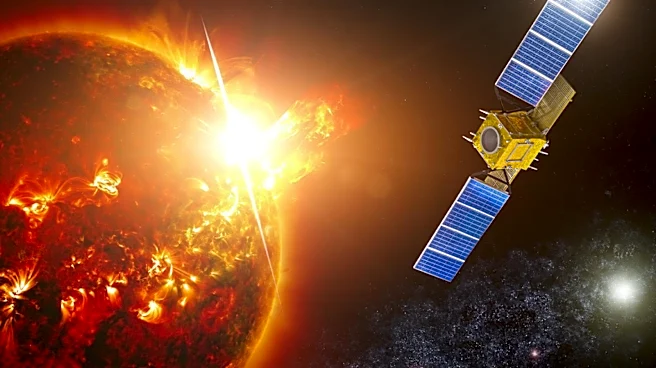








The Pioneer 6, 7, 8, and 9 space probes, part of NASA's broader Pioneer program, represented a significant leap in humanity's ability to understand the space environment around our Sun. Launched between 1965 and 1968, these four satellites, sometimes referred to as Pioneer A, B, C, and D, were designed to orbit the Sun and provide continuous measurements of interplanetary phenomena from widely separated points in space. Their collective mission was
to establish the world's first space-based solar weather network, offering crucial insights into solar activity and its effects on Earth.
Establishing a Global Solar Weather Network
The primary objective of the Pioneer 6, 7, 8, and 9 series was to achieve the first detailed global measurements of the solar wind, the Sun's magnetic field, and cosmic rays. These probes were specifically engineered to measure large-scale magnetic phenomena, as well as various particles and fields present in interplanetary space. By deploying multiple probes in different solar orbits, NASA created a distributed network capable of observing solar events from various vantage points. This innovative approach allowed scientists to gather comprehensive data that would be impossible to obtain from a single location.
The data collected by this network was instrumental in advancing the understanding of stellar processes, particularly the structure and flow of the solar wind. Beyond fundamental scientific research, the probes also served a practical purpose. They functioned as the world's inaugural space-based solar weather network, providing valuable information on solar storms. These storms have a direct impact on Earth's communications systems and energy infrastructure, making the data from the Pioneer probes critical for early warning and mitigation efforts. The ability to monitor these phenomena from space offered an unprecedented perspective on the dynamic nature of our star.
Interplanetary Orbits and Unique Perspectives
The Pioneer 6, 7, 8, and 9 probes were placed into heliocentric orbits, meaning they orbited the Sun. However, their specific orbital characteristics varied, which was key to their function as a network. Pioneer 6 and Pioneer 9, for instance, were in solar orbits with a distance of approximately 0.8 Astronomical Units (AU) from the Sun. Their orbital periods were slightly shorter than Earth's, allowing them to gradually drift ahead of our planet in their solar journey.
In contrast, Pioneer 7 and Pioneer 8 were positioned in solar orbits at a distance of about 1.1 AU from the Sun, resulting in orbital periods slightly longer than Earth's. This meant they would slowly fall behind Earth. The differing orbital periods of these probes were a deliberate design choice. Because their paths around the Sun did not perfectly match Earth's, they would, from time to time, face a side of the Sun that was not visible from Earth. This unique positioning allowed the probes to detect and report on solar activity, such as solar flares or coronal mass ejections, several days before the Sun's rotation would bring those active regions into view for ground-based or Earth-orbiting observatories. This early warning capability was a cornerstone of their role as a solar weather network.
Enduring Legacy and Operational Longevity
While designed for a primary mission duration of just six months, the Pioneer 6, 7, 8, and 9 probes far exceeded expectations, demonstrating remarkable operational longevity. Pioneer 7, for example, remained active for over 28 years, with its last contact occurring on March 31, 1995. Even after decades in space, some of its original instruments were still functioning. Similarly, Pioneer 6, launched in December 1965, continued to be contacted by NASA well into the 2000s, with its last contact on December 8, 2000, after 35 years of operation.
This extended operational life allowed the probes to gather an immense amount of data over several solar cycles, providing a long-term perspective on solar and interplanetary conditions. The insights gained from these missions laid foundational knowledge for subsequent space weather research and forecasting. The success of the Pioneer 6-9 series underscored the robustness of their design and the dedication of the teams that managed them for decades beyond their anticipated lifespan, solidifying their place as true pioneers in the study of our solar environment.