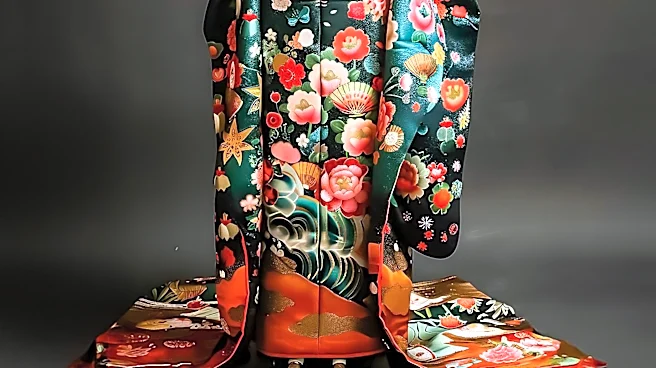

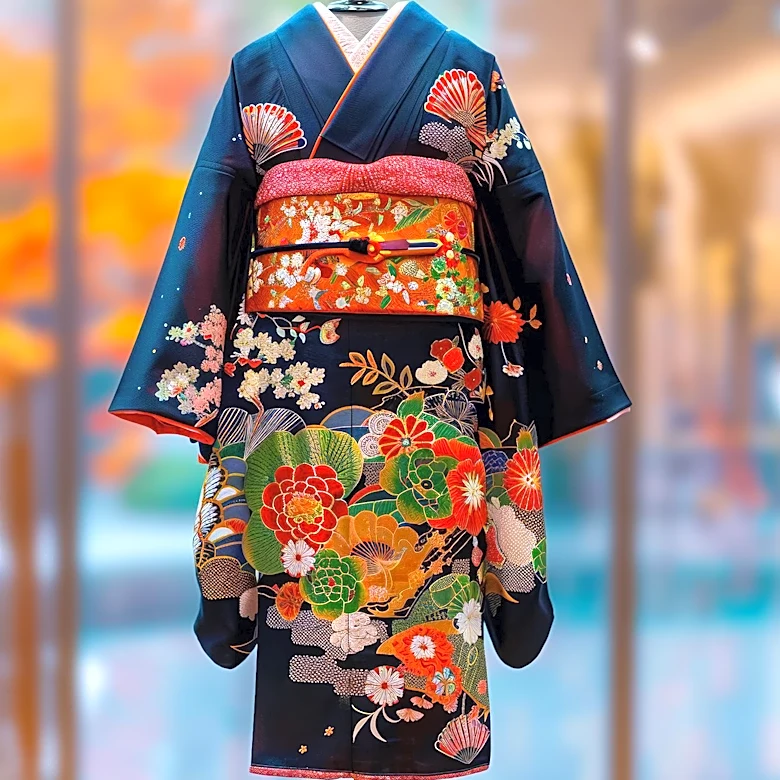


The kimono, a traditional Japanese garment, has a history stretching back centuries, with its fundamental T-shaped, straight-lined robe design largely remaining consistent for both men and women since the Heian period (794–1192). This enduring form, reaching to the ankles with a collar and wide sleeves, is wrapped around the body, always with the left side over the right, and secured by an obi sash. While the basic silhouette has persisted, variations
in color, fabric, style, and accessories have evolved, reflecting changing times and social customs.
Early Development and Core Design Principles
Originally, the term "kimono" referred to all types of clothing. The modern kimono's shape solidified during the Heian period, establishing a design that has seen remarkable continuity. This T-shaped robe features sleeves that, when arms are stretched horizontally, can fall from the wrist to about the hip, with some styles even reaching almost to the floor. The garment's construction is notably practical: it is traditionally made from a single bolt of fabric, known as a *tanmono*, which comes in standard dimensions. The entire bolt is utilized, typically consisting of four main strips of fabric—two for the body and two for the sleeves—along with smaller strips for the narrow front panels and collar.
This method of construction allows for the kimono to be easily taken apart, cleaned, and re-sewn. Historically, kimonos were completely disassembled for washing, a process called *arai-hari*, where each piece was washed and then stretched onto a board to dry before being re-sewn by hand. While modern fabrics and cleaning methods have reduced the necessity of this labor-intensive process, it is still practiced for high-end garments. The design also incorporates large, often uneven seam allowances, as the woven edges (*selvedges*) of the fabric bolt are retained, preventing fraying and allowing for resizing without damaging the material.
Adapting to Wearers and Occasions
Kimonos for women were traditionally made in essentially one size and adjusted to the individual's body through clamping and folding. However, modern kimonos for both men and women are increasingly available in various sizes. Individuals with larger or heavier builds, such as sumo wrestlers, often require custom-tailored kimonos. The garment's adaptability is also seen in its historical use of tucks for children: shoulder tucks (*kata-nuiage*) and a hip overfold (*koshi-nuiage*) allowed the kimono to be let out as a child grew. These tucks are now primarily seen on the kimonos of apprentice geisha in Kyoto, a remnant of a time when training began at a younger age.
For adult women, the excess length of most kimonos, which historically trailed on the floor, is now formally neatened into an *ohashori*, a hip fold that allows for fine length adjustments and takes up several inches of fabric. Men's kimonos, in contrast, are cut to the wearer's body length and secured with a narrow belt at the hips, without this extra fabric for an overfold. The evolution of the *obi*, the sash that holds the kimono closed, also reflects changing styles; while earlier *obi* were soft and pliable, modern ones are stiffer, requiring a series of flat ties (*himo*) to keep the kimono closed.
Layering and Modern Adaptations
Layering has been a significant aspect of kimono wear. Before World War II, three layers were standard over undergarments. These inner layers, known as *nakagi*, were often made from repurposed older kimonos. Formal layered sets, called *o-tsui*, featured matching designs on different background colors, with the outermost layer (*uwagi*) displaying the most extensive decoration. In contemporary Japan, at least one layer is typically worn next to the skin. This is traditionally a *hadagi* or *hadajuban*, a wrapped-front undergarment, though regular underwear is sometimes worn instead. Over this, a *nagajuban* (or *juban*), a lighter, thinner kimono-like garment, is worn, often with a removable collar cover (*han'eri*) that can be washed.
Today, elaborate layered kimonos are mostly seen on stage for classical dances or in kabuki theater. A common technique to create the illusion of layering without multiple full kimonos is the use of a *hiyoku*, a false second layer attached to the kimono. This can include a false collar and separate false sleeve cuffs. The enduring design of the kimono, from its fundamental T-shape to its adaptable construction and layering traditions, showcases a garment that has gracefully evolved while retaining its core identity through centuries of Japanese culture.