




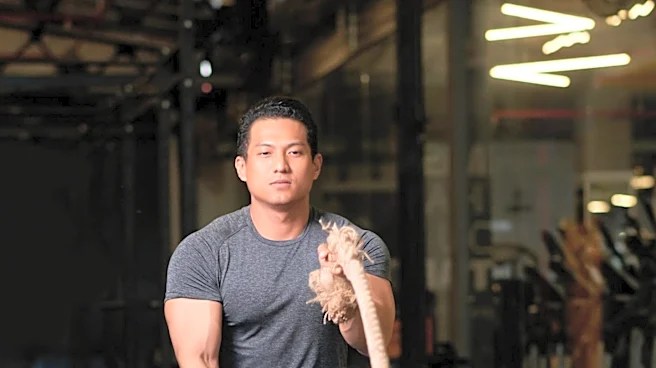

Power training is a specialized form of exercise designed to maximize the application of force as quickly as possible. This approach is rooted in the fundamental equation that strength combined with speed equals power. It involves various techniques, from lifting and throwing weights to more complex methods that integrate different types of exercises. The ultimate goal is to condition the body to perform with heightened nervous system activation and increased
muscle fiber recruitment, leading to a more powerful standard of movement.
Core Principles: Force and Velocity
At its heart, power training focuses on developing the ability to generate significant force rapidly. This can be seen in exercises like jumping with weights or throwing weights, where the emphasis is on explosive movement. Even regular weight training exercises, such as the clean and jerk or power clean, are considered power training due to the explosive speed required to complete these lifts. The integration of heavy lifting with dynamic movements, often referred to as complex training, is a key strategy to combine maximal lifting exertions with high-speed actions, thereby enhancing the overall capacity to apply power.
Two crucial physiological processes are frequently utilized and enhanced during power training. One is deep breathing, which leads to increased intra-abdominal pressure. The other is post-activation potentiation (PAP), a phenomenon where the nervous system's activation and muscle fiber recruitment are enhanced after certain exercises. These processes work in conjunction to prepare the body for more powerful movements. Power training programs can be tailored to improve general power application, meet specific sports criteria, or achieve both objectives.
Post-Activation Potentiation and Neuromuscular Activation
Post-activation potentiation, or the PAP effect, is a cornerstone of advanced power training. During exercise, particularly when lifting heavy weights, the nervous system becomes increasingly active, and a greater number of muscle fibers are recruited to aid performance. This heightened state of nervous system activation and muscle fiber recruitment persists for a period after the exercise. This residual effect can lead to an increased ability to apply power.
For example, if a light weight is lifted, followed by a heavy weight, and then the same light weight is lifted again, the light weight will feel lighter the second time due to the PAP effect from the heavy lift. In complex training, the PAP effect can be strategically used to make plyometric exercises more powerful. Similarly, in contrast loading, it can enhance the power of resistance-based exercises. The ultimate aim of incorporating PAP into a training regimen is to condition the trainee to perform with a consistently heightened nervous system activation and increased muscle fiber recruitment, thereby elevating their baseline power output.
The Role of Core Strength and Joint Integrity
Universal elements of effective power training include a strong core and robust joints. The body's core, encompassing the torso or trunk, serves as the foundation for all other movements. In power-intensive actions, core musculature is increasingly recruited to provide additional power. A stronger core also significantly improves a person's ability to balance. Comprehensive core strength training involves strengthening all parts of the core, including bending, straightening, circular movements, and isometric holds. Adding resistance as needed further enhances this training.
The more balanced and comprehensive the core training, the greater the benefits to a person's ability to apply power. This is partly because it prevents disproportionately weak core muscles from hindering the power output of stronger muscles they work with. For instance, if someone has strong bending and straightening core movements but weak rotational strength, a compound movement involving all three will be limited by the weakest link. The National Strength and Conditioning Association recommends a minimum exercise ratio of 1-1-1-1 for the four main core movements (flexion, extension, lateral flexion, and rotation) to ensure balanced development. Furthermore, strong and flexible joints are essential for applying and transferring power effectively. If a joint is too weak, the power that can be applied through it is limited, especially in dynamic movements requiring rapid force application and impact absorption. Strengthening joints in all ranges of motion, such as through varied running or hopping exercises, is crucial for both performance and injury prevention.