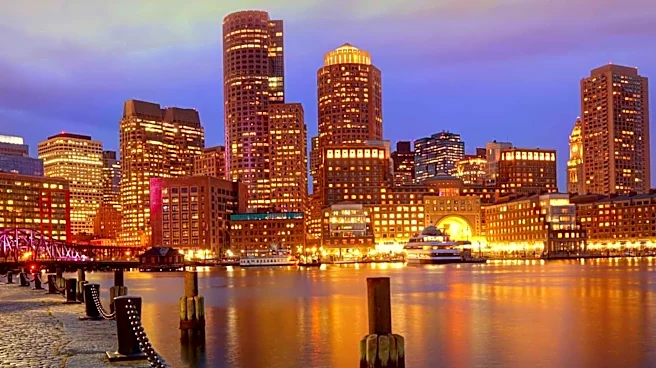






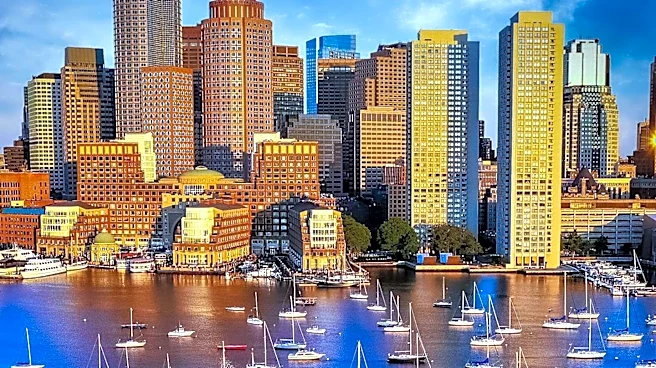

Boston, the capital and largest city in Massachusetts, holds a significant place in American history, tracing its origins back to a determined group of Puritan settlers. Founded on September 17, 1630, by English Puritans seeking religious freedom, the city quickly grew from a small settlement into a bustling center of commerce and culture. Its strategic location on the Massachusetts Bay, traversed by the Charles River, contributed to its early development
and its eventual rise as a major urban hub in the United States. The city's journey from a colonial outpost to a modern metropolis is marked by significant transformations, including land reclamation projects that dramatically reshaped its geography and economic shifts that redefined its identity.
The Puritan Foundations and Early Growth
The foundation of Boston was deeply influenced by Puritan ethics and their strong emphasis on education. This influence was evident even before the settlement's official founding, with the 1629 Cambridge Agreement establishing the Massachusetts Bay Colony. John Winthrop, the colony's first governor, played a pivotal role in this early period. The Puritans' commitment to learning led to the establishment of America's first public school, Boston Latin School, in 1635, underscoring the city's early dedication to intellectual pursuits.
Before the Puritans arrived, the first European resident in the area that would become Boston was William Blaxton, an Anglican cleric educated at the University of Cambridge. Blaxton was instrumental in the city's founding, inviting Puritan leader Isaac Johnson to cross Back Bay from the struggling Charlestown colony and share the peninsula. This invitation led to the Puritans making the crossing in September 1630, establishing what is now Boston.
Economic Evolution and Revolutionary Spirit
Boston's oceanfront location made it a vibrant port during the colonial era, engaging heavily in shipping and fishing. It served as a crucial stop on the Caribbean trade route, importing large quantities of molasses, which famously contributed to the creation of Boston baked beans. Until the mid-18th century, Boston was the largest town in the Thirteen Colonies, eventually being surpassed in wealth by New York City and Philadelphia. Despite this, Boston faced financial difficulties in the decades leading up to the American Revolution, even as other New England cities experienced rapid growth.
However, the city's economic stagnation did not diminish its revolutionary fervor. In the 18th century, Boston became a focal point of colonial resistance against new British taxes, and the American Revolutionary War effectively began in and around the city. After the Revolution, Boston's strong seafaring tradition helped it become one of the nation's busiest ports for both domestic and international trade. While the Embargo Act of 1807 and the War of 1812 temporarily curtailed harbor activity, Boston's merchants diversified their investments, leading to manufacturing becoming a significant component of the city's economy by the mid-19th century. The region's small rivers facilitated the shipment of goods and spurred the growth of mills and factories, further bolstered by a dense network of railroads.
Reshaping the Landscape: Land Reclamation and Urban Renewal
Between 1631 and 1890, Boston dramatically expanded its physical footprint through extensive land reclamation projects. These efforts tripled the city's area by filling in marshes, mud flats, and the spaces between wharves along the waterfront. Mid-19th-century reclamation projects were particularly impactful, creating substantial portions of areas now known as the South End, the West End, the Financial District, and Chinatown. This ambitious reshaping of the land allowed for continued urban development and growth.
By the early to mid-20th century, Boston experienced economic decline as its factories aged and businesses sought cheaper labor elsewhere. In response, the city initiated various urban renewal projects under the Boston Redevelopment Authority (BRA), established in 1957. One notable project in 1958 aimed to improve the historic West End neighborhood, but extensive demolition led to strong public opposition and the displacement of thousands of families. Despite some controversial outcomes, these efforts aimed to revitalize the city. The Columbia Point Health Center, the first Community Health Center in the United States, opened in 1965 in the Dorchester neighborhood, serving the large Columbia Point public housing complex. This health center, rededicated in 1990 as the Geiger-Gibson Community Health Center, remains in operation. The Columbia Point complex itself was redeveloped into the mixed-income Harbor Point Apartments between 1984 and 1990, showcasing ongoing efforts to adapt and renew the city's urban fabric.