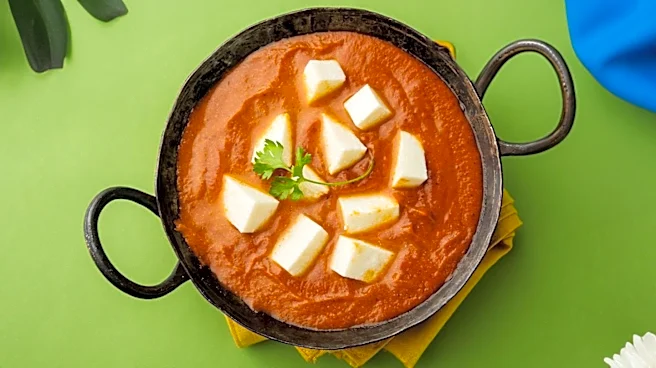










Paneer is a fresh, acid-set cheese widely used in South Asian cuisine, particularly prominent in North Indian dishes. Made from either cow or buffalo milk, it is characterized by its non-aged and non-melting properties, making it a unique ingredient in various culinary applications. Its versatility has led to its common use throughout India, appearing in a diverse range of dishes that cater to different regional traditions and tastes.
While paneer
is a staple today, its exact origins are not definitively known. Historical references to its existence are somewhat debated, with some theories suggesting ancient Indian roots in the Vedas, while others point to a Persian origin. Another interesting theory proposes that the Portuguese introduced the use of acid to form cheeses in the 17th century, which could have influenced the development or popularization of paneer as we know it.
The Etymology and Global Presence of Paneer
The term "paneer" itself has a rich linguistic history, entering English from the Hindi-Urdu word "panīr." This word, in turn, originates from the Persian "panir," which simply means 'cheese.' This Persian root is evident in various other languages across the region, where similar terms refer to cheese of any type. For instance, Armenian uses "panir," Azerbaijani has "pəndir," Bengali uses "ponir," and Turkish and Turkmen both have "peynir." Kurdish also uses "penîr," all deriving from the same ancient Persian source.
This widespread linguistic connection highlights the historical and cultural exchange of culinary practices and ingredients across South Asia and beyond. The presence of similar cheese-related terms in diverse languages suggests a long-standing tradition of cheese-making in these regions, even if the specific methods or types of cheese varied. Paneer, as a fresh cheese, stands out in this tradition due to its unique preparation and culinary role.
Crafting Paneer: From Milk to Curds
The preparation of paneer is a relatively straightforward process that involves curdling milk with an acidic agent. Hot milk, either from cows or buffaloes, is combined with a food acid such as lemon juice, vinegar, citric acid, or even dahi (yogurt). This acidic addition causes the milk to separate into solid curds and liquid whey. The curds are then carefully collected and drained.
Typically, the curds are placed in a muslin or cheesecloth, allowing the excess whey to drain away. To achieve the desired texture, the remaining water is pressed out. After this initial pressing, the resulting paneer is often submerged in chilled water for two to three hours. This step is crucial for improving both the texture and the overall appearance of the cheese. From this point, the specific preparation methods can diverge, depending on the intended use of the paneer and the regional culinary traditions.
Regional Variations and Culinary Applications
In North Indian cuisines, for example, the drained curds are commonly wrapped in cloth and placed under a heavy weight, such as a stone slab, for an extended period, typically two to three hours. This firm pressing results in a dense paneer that can be cut into cubes, ideal for use in rich curries. However, if a softer, fluffier cheese is desired, the pressing time can be significantly reduced to approximately 20 minutes. This flexibility in preparation allows paneer to be adapted for various dishes, from hearty main courses to lighter preparations.
The versatility of paneer is a key reason for its popularity. It absorbs flavors well and provides a satisfying texture, making it a beloved ingredient in vegetarian cooking. Its ability to be prepared with different levels of firmness further enhances its utility in the diverse culinary landscape of South Asia.