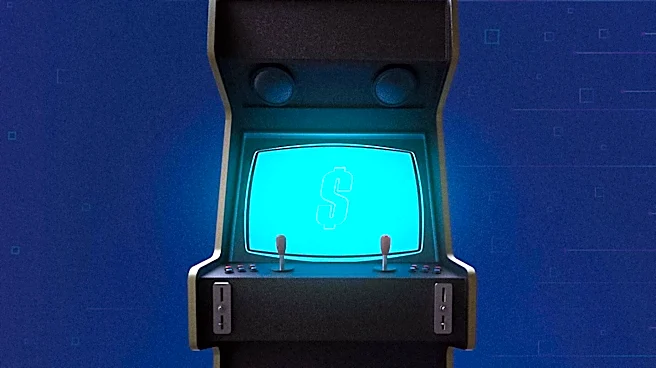









In the early 1970s, video games were largely confined to academic and research institutions, existing as novelties shared among programmers and technicians with access to powerful computers. This landscape began to shift dramatically with the introduction of *Computer Space* in 1971. Created by Nolan Bushnell and Ted Dabney, working together as Syzygy Engineering, *Computer Space* holds the distinction of being the first arcade video game and the first commercially
available video game, marking a pivotal moment in the history of interactive entertainment. Its release by Nutting Associates in November 1971 ushered in a new era, transforming video games from an exclusive academic pursuit into a potential commercial industry.
From Academic Novelty to Commercial Venture
The inspiration for *Computer Space* came directly from *Spacewar!*, a groundbreaking computer game developed in 1962 at the Massachusetts Institute of Technology. *Spacewar!* involved two players engaging in a spaceship dogfight against a starfield background, and it quickly spread to various computer installations across American academic institutions. This made it arguably the first video game to be widely available beyond a single research facility. Early computer scientist Alan Kay observed in 1972 that *Spacewar!* would "blossom spontaneously wherever there is a graphics display connected to a computer," highlighting its popularity within the small programming community of the 1960s.
Despite its widespread appeal among programmers, *Spacewar!* remained inaccessible to the general public due to the prohibitive cost of the hardware it ran on. The DEC PDP-1, for instance, was priced at $120,000 (equivalent to over $1.2 million in 2025) and only 53 units were ever sold, most without a monitor. This financial barrier prevented the original developers of *Spacewar!* from finding a viable way to monetize their creation. Bushnell and Dabney recognized this gap and set out to create a coin-operated version of *Spacewar!* that could be economically viable, leading to the development of *Computer Space*.
Engineering an Arcade Experience
Bushnell and Dabney initially explored running their game on a minicomputer like the Data General Nova but found it uneconomical. Their innovative solution was to replace the central computer with custom-designed hardware specifically built to run *Computer Space*. This approach allowed them to create a dedicated arcade machine that was far more cost-effective than using a general-purpose computer. While working on an early proof of concept, Bushnell secured a manufacturing partner in Nutting Associates, a company experienced in arcade game production.
The game's design was a marvel of early electronics. It did not use a microprocessor, which would not become common in arcade games until 1975. Instead, the entire computer system was a state machine constructed from 7400-series integrated circuits, with monochrome graphic elements stored in diode arrays. Bushnell ingeniously designed these arrays to allow the player's rocket to rotate in 32 directions using only four arrays, and their layout in the shape of the ships made it easy for operators to identify and replace broken components. These arrays also allowed for independent movement of graphic elements, a significant improvement over *Spacewar!*'s method of refreshing the entire screen for every change. The ships themselves were rendered as patterns of dots, an early form of what would later be known as sprite graphics. The cabinet itself was a custom fiberglass unit, designed by Bushnell to evoke a futuristic aesthetic, and it housed a specially modified 15-inch General Electric black and white television screen as its monitor.
Market Reception and Legacy
After completing the game, Syzygy conducted location tests, installing a prototype at the Dutch Goose bar in Menlo Park, California. This initial test was highly successful, encouraging Nutting Associates to prepare finished cabinets for the Music Operators of America (MOA) Music & Amusement Machines Exposition in October 1971. However, further location tests revealed a mixed response; many customers found the game's mechanics and controls confusing. Syzygy quickly revised the game's instructions to improve player understanding.
Despite some initial hesitation from distributors at the MOA show, Nutting Associates proceeded with a large production run. *Computer Space* entered initial production in November or December 1971, with full production beginning around late January 1972. The game sold over 1,000 cabinets by mid-1972, ultimately reaching 1,300–1,500 units. While not the "runaway success" Nutting had hoped for, it was a significant achievement that validated Syzygy's belief in the future of arcade video games. *Computer Space* spawned one clone game, *Star Trek* (1972), and Nutting later produced a two-player version in 1973. Its pioneering role as the first commercial video game laid the groundwork for the burgeoning arcade industry that would soon follow.