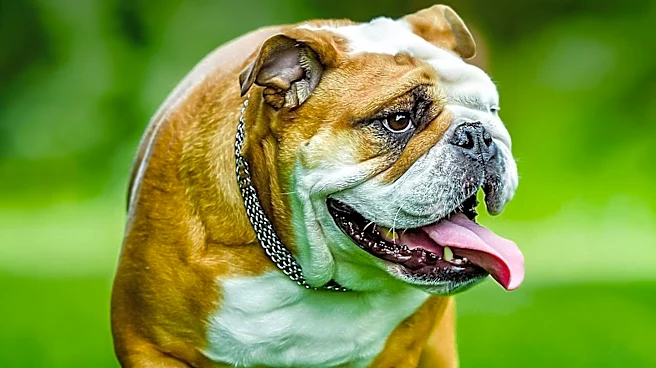








The Bulldog, also known as the English Bulldog or British Bulldog, is a distinctive British breed of dog belonging to the mastiff type. This stocky, muscular dog is characterized by its large head, thick folds of skin around its face and shoulders, and a relatively flat face with a protruding lower jaw. While today's modern Bulldog is generally a friendly and amiable companion, its history is deeply rooted in the brutal sport of bull-baiting, a practice
that shaped its physical characteristics and temperament over centuries before its eventual outlawing led to a transformation of the breed into the pet we recognize today.
Origins in Bull-Baiting
The designation "bull" in the Bulldog's name directly refers to its historical use in bull-baiting. This sport involved setting dogs onto a tethered bull, with wagers placed on each dog. The objective was for a dog to grab the bull by the nose and pin it to the ground, thereby claiming victory. This dangerous activity often resulted in severe injury or death for the dogs, as bulls could gore, toss, or trample them.
Over many centuries, the dogs used for bull-baiting underwent selective breeding, developing the stocky bodies, massive heads, and powerful jaws that are still characteristic of the breed. Along with these physical traits, a ferocious and savage temperament was also cultivated to suit the demands of the sport. The earliest known reference to the word "Bulldog" dates back to 1631 or 1632, appearing in a letter from Preswick Eaton requesting "two good Bulldogs" to be sent by ship. In 1666, English scientist Christopher Merret further documented the breed, referring to it as "Canis pugnax, a Butchers Bull or Bear Dog."
The Outlawing of a Brutal Sport
Bull-baiting was eventually made illegal in England with the passage of the Cruelty to Animals Act in 1835. This legislative change marked a significant turning point for the Old English Bulldog, as its primary "working" purpose in England ceased to exist. With the sport outlawed, the breed's days as a sporting animal were numbered, leading to a decline in its original form.
However, the utility of such dogs was still recognized in other parts of the world. In the mid-17th century, for instance, Bulldogs were employed in New York as part of a citywide effort led by Governor Richard Nicolls to round up wild bulls. Due to the inherent dangers of cornering and leading these animals, Bulldogs were trained to seize a bull by its nose, holding it long enough for a rope to be secured around its neck. This demonstrates a transitional period where the breed's strength and grip were still valued, albeit for different, more practical purposes.
The Rise of the Companion Bulldog
Following the ban on bull-baiting, the focus of Bulldog breeding shifted dramatically. The modern Bulldog was intentionally bred as a companion dog, moving away from the aggressive traits necessary for its former role. This transformation was championed by individuals like dog dealer Bill George, who actively promoted Bulldogs as pets. The breed's temperament evolved to become generally friendly and amiable, a stark contrast to its ancestors.
The establishment of breed clubs played a crucial role in standardizing and promoting the new companion Bulldog. The first Bulldog Club was founded in 1864 by a group of breeders under R. S. Rockstro, though it was short-lived. Its main contribution was the detailed description of the Bulldog known as the Philo-Kuan Standard, published in 1865. The Kennel Club, founded in 1873, further solidified the breed's status, including Bulldogs in its first Stud Book in 1874. The third Bulldog Club, established in March 1875, proved to be enduring and still exists today. This club, meeting frequently at the Blue Post pub in London, developed a new standard for the English Bulldog, published on May 27, 1875, and held its first breed show that same year. It was granted corporate status in 1894 as "The Bulldog Club, Inc.," becoming the oldest mono-breed dog kennel club in the world. The American Kennel Club officially recognized the Bulldog in 1886. By 2013, the Bulldog had become the twelfth-most-frequently registered breed worldwide, a testament to its successful transition from a fighting dog to a beloved global pet.
Health Challenges and Modern Appearance
Despite its popularity, selective breeding for appearance has introduced various health challenges for the modern Bulldog. These include increased susceptibility to conditions such as brachycephaly, hip dysplasia, and heat sensitivity. Concerns about the quality of life for these dogs have even led to breeding being made illegal in the Netherlands.
An interesting historical comparison occurred in 1894 when two top Bulldogs, King Orry and Dock Leaf, competed in a 20-mile walk. King Orry, resembling the original Bulldogs, was lighter-boned and athletic, while Dock Leaf was smaller and heavier set, more akin to modern Bulldogs. King Orry won, completing the walk, while Dock Leaf collapsed and died. This event highlights the significant physical changes the breed has undergone. Today's Bulldogs, while tough in appearance, can no longer perform the tasks they were originally bred for, lacking the stamina for rigorous activity and the muzzle length for a strong grip, underscoring their complete transformation into a companion animal.