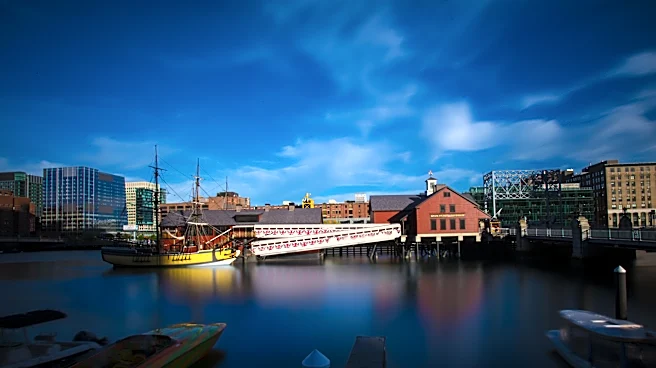
The Boston Tea Party is widely recognized as a pivotal 1773 colonial protest that foreshadowed the American Revolution. However, the name “Boston Tea Party” extends far beyond this singular historical event, having been adopted by a variety of organizations, cultural phenomena, and even commercial ventures. This shared nomenclature highlights the enduring impact and symbolic resonance of the original protest, even as its meaning diversifies across
different contexts. From political parties to concert venues and even television shows, the phrase has found a surprising range of applications, each carrying its own unique significance.
Political Echoes: The Boston Tea Party (Political Party)
One notable modern namesake is the Boston Tea Party (political party), a libertarian U.S. political party established in 2006. This party was founded in direct objection to new policy changes announced by the Libertarian Party at its Oregon convention in the same year. The Boston Tea Party political party advocated for a significant reduction in the size, scope, and power of government at all levels and on all issues, while opposing any increase in governmental authority for any purpose. Prominent libertarian figures, such as economist Walter Block, publicly expressed a preference for the Boston Tea Party's candidates over those of the Libertarian Party, citing discomfort with the "unlibertarian" history of the Libertarian Party's 2008 presidential candidate, Bob Barr, a former Republican congressman. The party even gained a moment of national recognition when it was featured as a $2,000 clue on an April 2011 episode of *Jeopardy!* in a category titled "The Mad Tea Party." However, the party faced challenges, and by July 2012, with only two remaining members on its National Committee, the resignation of its chair, Darryl Perry, effectively led to its disbandment.
Cultural Venues and Media: From Concerts to Television
The name "Boston Tea Party" has also been adopted by various cultural entities. In Boston, Massachusetts, during the late 1960s, a concert venue operated under this name, becoming a significant hub for rock music. This venue hosted numerous famous artists of the era, contributing to the vibrant music scene of the time. Beyond music, the name has crossed international borders into television, with a Swedish TV show also bearing the title "Boston Tea Party." This demonstrates the global reach and adaptability of the name, allowing it to resonate in different cultural landscapes. The historical event's dramatic nature and association with protest likely contribute to its appeal as a title for diverse media.
Commercial and Cinematic Interpretations
Further diversifying its usage, the "Boston Tea Party" name is also associated with a chain of cafés in England, indicating its adoption in the commercial sector. This commercial application suggests that the name carries connotations of tradition, perhaps even a certain rebellious spirit, that can be leveraged for branding. The historical event has also inspired multiple cinematic interpretations. Films such as *The Boston Tea Party* from 1908 by Edwin S. Porter, another film in 1915 by Eugene Nowland, and a 1934 film narrated by John B. Kennedy, all attest to the enduring narrative power of the original protest. These various uses—political, cultural, commercial, and cinematic—underscore how a single historical event can lend its name to a wide array of unrelated ventures, each drawing on different aspects of its symbolic legacy.