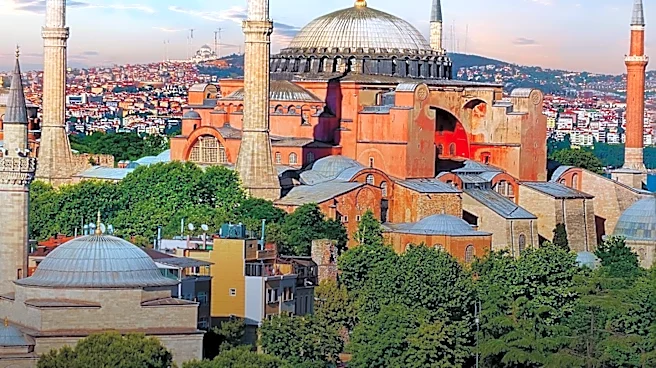







The name Hagia Sophia, meaning 'Holy Wisdom,' is famously associated with the grand mosque in Istanbul. However, this revered name has been bestowed upon several other significant religious structures across Turkey and Greece, each with its own unique history, architectural style, and journey through various religious and political transformations. These other Hagia Sophias, while perhaps less globally renowned than their Istanbul counterpart, offer
fascinating insights into regional Byzantine architecture and the complex cultural heritage of the Eastern Mediterranean.
The Hagia Sophia of Trabzon: A Thirteenth-Century Gem
In Trabzon, northeastern Turkey, stands another Hagia Sophia, a formerly Greek Orthodox church that was converted into a mosque following the conquest of Trabzon by Mehmed II in 1461. This building dates back to the thirteenth century, a period when Trabzon served as the capital of the Empire of Trebizond. Located near the seashore, two miles west of the medieval town's limits, it is considered one of the finest examples of Byzantine architecture in the region. Its construction took place between 1238 and 1263, during the reign of Manuel I.Like its more famous namesake, the Hagia Sophia of Trabzon has also experienced multiple changes in its function. It was converted into a museum in 1964 and then back into a mosque in 2013. The church's design features a high central dome and four large column arches supporting the dome and ceiling, characteristic of late Byzantine architecture. Below the dome, an Opus sectile pavement of multicolored stones adds to its artistic value. The structure is 22 meters long, 11.6 meters wide, and 12.7 meters tall, built with a cross-in-square plan that gives its exterior the shape of a cross due to prominent north and south porches.
Thessaloniki's Hagia Sophia: A UNESCO World Heritage Site
In Thessaloniki, Greece, the Hagia Sophia church stands as one of the city's oldest surviving churches, with its current structure dating from the 7th century. This church is recognized for its outstanding Byzantine art and architecture, as well as its importance in early Christianity, earning it a place as a UNESCO World Heritage Site in 1988. Its history traces back to the 3rd century, with a previous church on the site collapsing in 620, likely due to an earthquake. The present structure, erected later in the 7th century, was based on the design of the Hagia Sophia in Constantinople.This Hagia Sophia also underwent periods of conversion. In 1205, during the Fourth Crusade, it became the cathedral of Thessaloniki until 1224. After the Ottoman conquest of Thessaloniki in 1430, it was converted into a mosque, known as Ayasofya Camii, retaining its original name. It was reconverted to a church upon the liberation of Thessaloniki in 1912. Its ground plan is a domed Greek cross basilica, a significant architectural type of the Byzantine middle period. The church's apse was adorned with plain gold mosaics during the Iconoclastic era, later replaced by an image of the Theotokos. The dome features a mosaic of the Ascension, surrounded by figures of the Twelve Apostles, Mary, and two angels.
Other Notable Hagia Sophias: Drama and İznik
Further illustrating the widespread use of the name, the Church of Hagia Sophia in Drama, Greece, is a 10th-century Byzantine church and the oldest preserved building in the town. Built on the highest point of the area, it was likely dedicated to the Virgin Mary and constructed on the site of an earlier Christian basilica. This church was converted into a mosque by the Ottoman Turks in 1430, or possibly earlier during the reign of Sultan Murad I, and was known as Bey Mosque. It was converted back into a Christian church after the Balkan Wars and rededicated to the holy wisdom of God in 1922 by Greek refugees.In İznik (Nicaea), Turkey, another Hagia Sophia mosque, originally a Byzantine-era basilican church, also tells a similar story of transformation. Built as an Eastern Orthodox church, it was converted into the Orhan Mosque after the Ottoman conquest, then became a museum in 1935, and was later reconverted to a mosque in 2011. The current basilican structure, largely from a 1065 reconstruction, features a central nave with two side aisles. Its renovations under the Ottomans included the addition of a mihrab and a minaret, with Mimar Sinan commissioned to design decorations in the 16th century. These examples collectively demonstrate the enduring legacy and adaptability of structures bearing the name Hagia Sophia across different cultures and centuries.