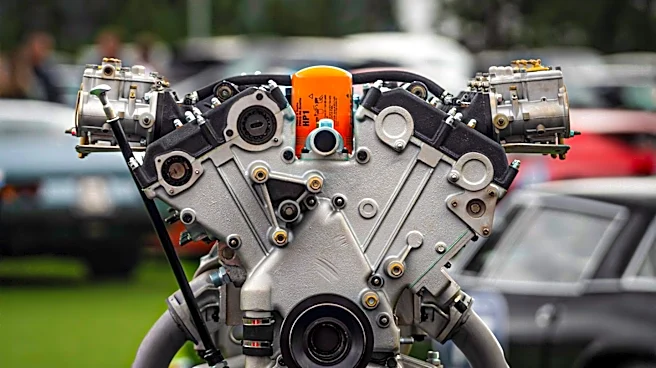





Volkswagen Group has notably adopted twincharger technology, particularly in its 1.4-liter TSI engine, to achieve a compelling balance of performance and fuel economy. This approach, which combines a turbocharger and a supercharger, was first introduced to the market with the 1.4 TSI Twincharger engine, offered in variants producing 170 and 140 horsepower. This innovative engine was initially featured in models such as the Golf and the Touran, demonstrating
Volkswagen's commitment to advanced engine design. The twincharger system is a key component in Volkswagen's strategy of displacement downsizing, allowing smaller engines to deliver power comparable to larger units while consuming less fuel.
The EA111 Twincharger Engine
The 125 kW 1.4-liter TSI engine, based on the EA111 platform, was unveiled at the 2005 Frankfurt Motor Show. This engine is a prime example of a twincharger setup, utilizing both a turbocharger and a supercharger. The primary benefit of this configuration is improved fuel economy, with Volkswagen reporting 14% more power than the 2.0 FSI engine while consuming 5% less fuel. This efficiency gain is largely attributed to the ability of the twincharger system to provide optimal boost across a wide range of engine speeds, avoiding the compromises often associated with single forced induction systems.
The operational strategy of Volkswagen's twincharger is carefully orchestrated. The mechanical supercharger, which is driven at five times the speed of the crankshaft, is primarily responsible for operation at low engine speeds, from idle up to approximately 2,400 revolutions per minute (rpm). During this phase, the supercharger provides a significant boost pressure of 1.75 bar (25.4 psi), ensuring strong low-end torque and immediate throttle response. This effectively eliminates turbo lag, a common issue with turbocharger-only systems where there's a delay before the turbocharger spools up and delivers full power.
Seamless Transition and Efficiency
As engine speeds increase, the turbocharger gradually assumes full effectiveness. The engine management system then disengages the clutch-controlled supercharger at a specific point, allowing the turbocharger to take over the primary role of forced induction. This seamless transition is crucial for maintaining continuous power delivery and optimizing efficiency. By decoupling the supercharger when the turbocharger is fully operational, the parasitic losses associated with the mechanically driven supercharger are minimized, contributing to better fuel economy at higher speeds.
This intelligent management of both compressors allows the Volkswagen 1.4 TSI Twincharger engine to deliver robust performance across the entire rev range. The supercharger ensures brisk acceleration from a standstill and strong torque in urban driving conditions, while the turbocharger provides sustained power for highway cruising and higher-speed demands. The ability to switch between or combine these two forced induction methods allows Volkswagen to achieve a highly efficient and responsive engine, showcasing the practical advantages of twincharging in modern automotive applications.