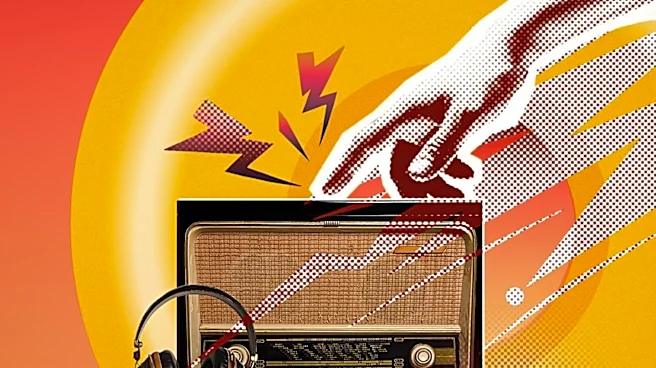






WHSQ, an AM radio station in New York City, has a rich and complex history spanning nearly a century, marked by numerous call sign changes, shifts in ownership, and evolving programming formats. What began as Alfred H. Grebe's WAHG in 1924 has transformed through various iterations, including a long tenure as WABC and WCBS, before adopting its current identity and sports format. This journey reflects the dynamic nature of the broadcasting industry
and the station's enduring presence in the competitive New York media landscape.
Early Beginnings and CBS Affiliation
The station first signed on in September 1924 as WAHG, operating with a 500-watt license on 950 kHz, under the ownership of Alfred H. Grebe & Company. It was an early pioneer in New York radio, known for broadcasting remote events like horse races and yachting competitions. In December 1926, Grebe seized an opportunity when a North Carolina station, also named WABC, changed its call sign to WWNC. Grebe promptly adopted the WABC call sign for his New York station, reflecting a change in ownership to the Atlantic Broadcasting Company. On December 17, 1926, the new WABC, now a 5 kW super-power station, debuted from 113 West 57th Street with a gala concert.
Grebe's Atlantic Broadcasting Company eventually held licenses for four stations in the New York City area: WABC, WBOQ, and two portable stations, WGMU and WRMU. However, the newly established Federal Radio Commission (FRC) found the regulation of portable stations too challenging, leading to the discontinuation of WGMU and WRMU on July 31, 1928. On November 11, 1928, WABC and WBOQ were formally consolidated as WABC-WBOQ, and their combined operation moved to the 860 kHz clear channel frequency under FRC General Order 40. This consolidated station became a part-time network affiliate for the Columbia Broadcasting System (CBS), which was seeking a full-time radio outlet in New York City. CBS programming had previously been broadcast part-time on WOR, which later contributed to the formation of the Mutual Broadcasting System.
CBS Ownership and the Shift to All-News
After a brief period broadcasting CBS programming three days a week, WABC-WBOQ was acquired by CBS president William S. Paley, becoming a full-time CBS Network owned and operated station. The station significantly increased its transmitting power from 5,000 to its current 50,000 watts, the maximum allowed by the FCC. Its studios relocated to the CBS headquarters at 485 Madison Avenue, and later in 1939, broadcasting operations moved across 52nd Street to the new CBS Studio Building. During this era, the station offered a diverse mix of local interest programs, dramas, comedies, news, sports, and music from CBS's national feed. Over time, WABC increasingly relied on national CBS programming, with CBS's growing interest in news influencing its broadcast day.
In 1946, the station changed its call letters to WCBS, a name it would retain for 78 years. A pivotal moment in its history occurred in 1967 when WCBS adopted an all-news format, entering into direct competition with WINS (1010 AM). This move was part of CBS Radio's broader strategy to convert its AM stations to news programming. Following WCBS's successful transition, other CBS-owned stations like KCBS, KNX, and WBBM also adopted all-news formats in 1968. WEEI followed in 1974, and WCAU in 1975. While CBS stations in Boston, Chicago, and San Francisco enjoyed a monopoly on the all-news format, those in New York, Los Angeles, and Philadelphia faced competition from Westinghouse-owned stations that had adopted the format earlier. The all-news format on WCAU, for instance, lasted only three years, partly due to KYW's ten-year head start in Philadelphia. In contrast, other CBS all-news stations found success and stability with the format.
Mergers, Ownership Changes, and the Modern Era
In 1995, a significant industry consolidation occurred when Westinghouse merged with CBS, making WCBS a sister station to its long-time rival, WINS. This merger brought two of New York's prominent all-news stations under the same corporate umbrella. In October 2000, WCBS moved its operations from the CBS corporate headquarters at 51 West 52nd Street, known as "Black Rock," to the CBS Broadcast Center at 524 West 57th Street. Around this time, the station began branding itself as "Newsradio 880." A further relocation took place on December 2, 2011, when operations moved to 345 Hudson Street, the Hudson Square Broadcast Center, where it shared space with other CBS Radio stations in New York.
Another major shift in ownership happened on February 2, 2017, when CBS agreed to merge CBS Radio with Entercom, then the fourth-largest radio broadcaster in the United States. This transaction, structured as a Reverse Morris Trust for tax benefits, resulted in Entercom becoming the surviving entity, effectively separating WCBS radio (both 880 AM and 101.1 FM) from WCBS-TV. The merger was approved on November 9, 2017, and consummated on November 17. As part of the agreement, Entercom was granted rights to use the WCBS brand and trademarks for 20 years. Before this merger, CBS Radio operated nine of the country's largest all-news stations. In October 2022, after Audacy (formerly Entercom) reached a new deal with SAG-AFTRA, the separate staffs and newsrooms of WCBS and WINS were combined. WNYL (92.3 FM) also became an FM simulcast of WINS, while WCBS remained exclusively on AM radio and an HD Radio digital subchannel of 101.1 WCBS-FM.
In August 2024, Audacy announced the end of WCBS's 57-year all-news format. The station entered into a local marketing agreement (LMA) with Good Karma Sports (GKS) to operate under a sports format, subsuming the programming of WEPN-FM due to the expiration of GKB's LMA for that station. This marked the end of an era for WCBS as an all-news station and its transition to WHSQ, broadcasting a sports format as part of ESPN Radio. WHSQ currently carries a mix of local and ESPN Radio national programming and serves as the flagship of the New York Mets Radio Network, with Audacy retaining the rights and selling advertising during Mets broadcasts. The station is promoted by Audacy as "Mets Radio 880," and its associated stream on the Audacy app carries Westwood One Sports programming outside of Mets games. Its transmitter is located on High Island in the Bronx, and its 50,000-watt clear channel signal can be heard at night throughout much of the eastern United States and Canada.