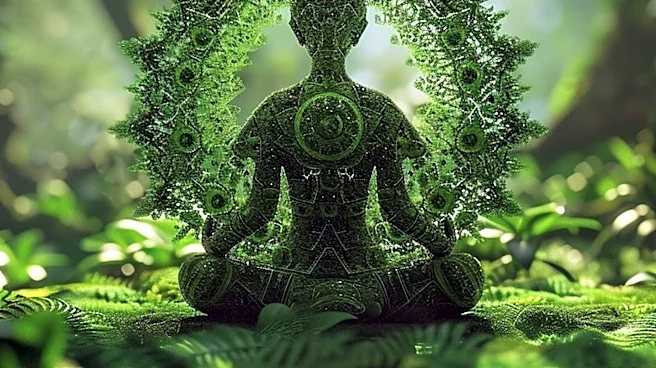








Anahata, the fourth primary chakra in Hindu yogic, Shakta, and Buddhist tantric traditions, is deeply associated with the heart region. This chakra is not merely a physical location but a profound concept linked to balance, emotional regulation, compassion, and relational awareness. In Sanskrit, Anahata translates to "unstruck" and also "pure" or "clean, stainless." It signifies a state of freshness that emerges when an individual achieves detachment,
allowing them to view life's diverse and often contradictory experiences with an open perspective. This openness is crucial for integrating opposing forces, leading to a sense of peace and a new outlook on the world.
At its core, Anahata represents a pivotal shift in an individual's spiritual journey. Unlike the lower chakras, where decisions might be influenced by karma and fate, Anahata is where one makes choices based on their higher self. This means moving beyond the unfulfilled emotions and desires that characterize lower nature, and instead, following one's heart. This capacity for making decisions free from karmic bonds is a defining characteristic of the heart chakra, emphasizing a conscious and compassionate approach to life.
The Unstruck Sound and Integration of Opposites
The etymology of Anahata, meaning "sound produced without touching two parts," offers a profound insight into its function. It describes the ability to achieve an effect, or a "sound," without the direct confrontation of two opposing forces. This concept is central to understanding the chakra's role in fostering cooperation and integration. Normally, people are unaccustomed to the effects generated by the clash of opposite forces. However, at the level of Anahata, the possibility arises to integrate these seemingly contradictory experiences, leading to a harmonious outcome without direct conflict. This energy is inherently linked to cooperation and integration, which ultimately brings peace and a fresh perspective.
This integration extends to the individual's internal landscape, allowing for a more balanced emotional state. The ability to regulate emotions and approach relationships with awareness stems from this central point. It is a space where love and compassion are not just feelings but active principles guiding one's interactions and decisions. The "unstruck" quality suggests a pure, unadulterated essence that is not subject to the friction and discord often found in the material world.
Symbolism and Spiritual Qualities
Anahata is visually represented by a lotus flower with twelve petals, enclosing a smoky region at the intersection of two triangles, forming a shatkona. This shatkona is a significant symbol in Hindu Yantra, representing the union of male and female principles, specifically Purusha (the Supreme Being) and Prakriti (Nature). The deity associated with this area is Vayu, depicted as smoke-like and four-armed, holding a kusha and riding an antelope, which is the chakra's animal. The imagery of a "fourth chakra person" having innocent eyes, like those of a deer, further emphasizes purity and gentleness.
The twelve petals of the Anahata chakra are inscribed with Sanskrit syllables, which are often associated with various divine qualities or vrittis of the heart. These qualities include bliss, peace, harmony, love, understanding, empathy, clarity, purity, unity, compassion, kindness, and forgiveness. While some systems identify these vrittis as arising from spiritual ignorance, others, like William Enckhausen, suggest that half are "positive, growth-promoting" and half are "negative or at most neutral, self-justifying defense tendencies." This highlights the Anahata's role as a fulcrum for discriminating between virtue and vice, promoting spiritual growth, and expanding beyond ego's limited boundaries. It is a center where the potential to discern what is beneficial for the self and what is inappropriate for spiritual development becomes clear, fostering a sense of harmony, balance, and proportion.