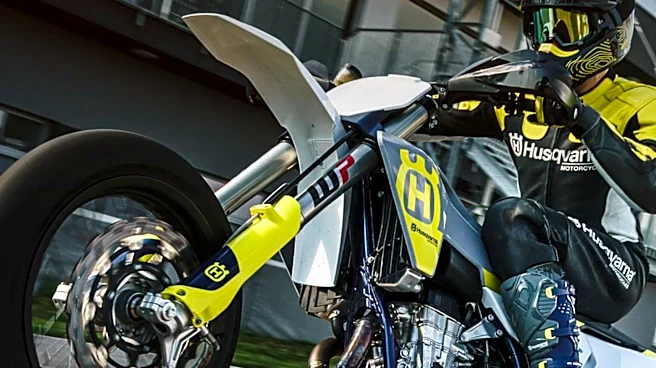






Supermoto, a dynamic form of motorcycle racing, boasts a fascinating origin story rooted in American television and a quest to identify the ultimate all-around motorcycle racer. What began as a made-for-TV event in the late 1970s has since evolved into a distinct global sport, culminating in the FIM S1GP Supermoto World Championship. This journey highlights the sport's adaptability and its enduring appeal to both riders and fans.
The initial concept
for Supermoto emerged in 1979, conceived by motorcycling journalist and promoter Gavin Trippe. At the time, ABC's "Wide World of Sports" was a highly-rated sports program in the United States, and Trippe's idea was to create an event that would bring together top riders from different motorcycle racing genres. The goal was to find a single champion who could excel across various disciplines, testing their skills on a unique track that combined elements of flat track racing, motocross, and road racing.
The Birth of "Superbikers" and Early Success
This innovative concept materialized as the "Superbikers" event, commissioned by ABC. It was designed to be an all-star game, allowing the best riders from separate motorcycle racing categories to compete for the title of the best all-around racer. The Superbikers quickly became a significant draw, held annually at southern California's Carlsbad Raceway. The track design was crucial, featuring tarmac and dirt courses specifically intended to challenge talent from off-road, flat track, and road racing backgrounds.
World and National Championship-winning motorcycling greats, such as Kenny Roberts, known for road racing, and Jeff Ward, a motocross star, participated in these early races. Their involvement underscored the event's prestige and its success in attracting top-tier talent. The Superbikers proved to be a huge contender in Nielsen ratings, demonstrating its popularity with the American viewing public. This yearly event continued to run until 1985, establishing a foundational legacy for the sport.
A Sabbatical and International Resurgence
Despite its success, the Superbikers event faced an unexpected halt in 1985. New management at ABC and budget cuts led to the cancellation of the show, initiating a long sabbatical for the sport in the United States. However, the concept had planted a seed that would eventually blossom internationally. The unique blend of racing disciplines proved too compelling to fade away entirely.
It wasn't until 2002 that the Supermoto World Championship was officially born, marking a significant international resurgence for the sport. This new championship initially featured a single, free displacement category. The first rider to claim a world title in this new era was the French rider Thierry Van Den Bosch, signaling the sport's global appeal and the shift in its competitive landscape. This championship, organized by FIM, became the premier competition for supermoto racing, taking place annually as a calendar competition across various international locations.
Championship Structure and Key Developments
Since its inception in 2002, the FIM Supermoto World Championship has seen structural changes. Initially, it featured a single S1 class. Between 2004 and 2009, a second class, S2, was introduced and contested as a world championship before being dropped. Since 2010, the competition has reverted to a single S1 class. Another notable development occurred in 2006 with the introduction of a mono-tyre rule, initially supplied by Dunlop, then Goldentyre in 2010, and Michelin in 2016. The most successful rider in the history of the FIM S1GP Supermoto World Championship is Frenchman Thomas Chareyre, who has secured eight titles, cementing his place as a legend in the sport.