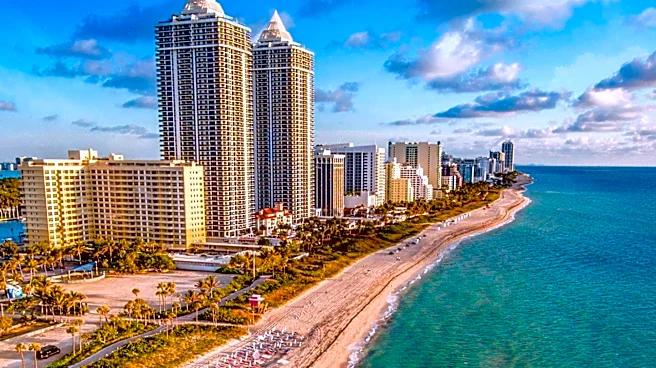








Miami Beach, Florida, a principal city within the Miami metropolitan area, has a rich history of transformation. What began as an uninhabited oceanfront bar has evolved into one of America's preeminent beach resorts. This journey involved ambitious land purchases, failed agricultural ventures, and the vision of several key developers who saw the potential in the sandy strip between the Atlantic Ocean and Biscayne Bay. The city's development was marked
by significant engineering feats, strategic promotions, and the eventual establishment of a vibrant resort community.
Early Land Purchases and Failed Ventures
In 1870, the initial steps toward developing Miami Beach were taken when Henry and Charles Lum purchased land for 75 cents an acre. This early acquisition laid the groundwork for future endeavors, though the area remained largely undeveloped for some time. The first structure to appear on this oceanfront was the Biscayne House of Refuge, built in 1876 by the United States Life-Saving Service. Established through an executive order by President Ulysses S. Grant, its purpose was to offer aid, including food, water, and a path back to civilization, for shipwrecked individuals. Located around 72nd Street, this structure eventually fell into disuse and was destroyed by the 1926 Miami Hurricane, never to be rebuilt.The 1880s saw New Jersey entrepreneurs Ezra Osborn and Elnathan T. Field attempt to establish a coconut plantation along the shore of Miami Beach. However, this venture ultimately failed. One of the investors in this project was agriculturist John S. Collins. Collins later found success by buying out his partners and cultivating different crops, notably avocados, on the land that would eventually become Miami Beach. The pine trees lining Pinetree Drive served a practical purpose, acting as an erosion buffer for Collins's plantations, highlighting the early challenges of developing this coastal environment.
Connecting the Island: Bridges and Boom
While development was slowly progressing on the beach, the City of Miami was established across Biscayne Bay in 1896 with the arrival of the railroad. Its growth as a port was further enhanced in 1905 with the creation of the Government Cut shipping channel, which separated Fisher Island from the southern end of the Miami Beach peninsula. Collins's family members recognized the potential for developing the beach into a resort. This effort gained momentum in the early 20th century, spearheaded by the Collins/Pancoast family, the Lummus brothers (bankers from Miami), and Indianapolis entrepreneur Carl G. Fisher.Before this period, the beach was primarily a destination for day trips via ferry from Miami. By 1912, Collins and Pancoast were actively clearing land, planting crops, overseeing the construction of canals to transport their avocado harvest to market, and establishing the Miami Beach Improvement Company. Early amenities included bathhouses and food stands, but a hotel wouldn't appear until Brown's Hotel was built in 1915, which still stands today at 112 Ocean Drive. Much of the interior landmass at the time was a dense mangrove jungle. Clearing this, deepening channels and water bodies, and replacing native growth with landfill for development proved to be an expensive undertaking. What began as a 1600-acre, jungle-matted sandbar three miles out in the Atlantic eventually expanded to 2,800 acres once dredging and filling operations were completed.
With financial assistance from the Lummus brothers, Collins initiated work on a 2.5-mile-long wooden bridge, which was, at the time, the longest wooden bridge in the world, designed to connect the island to the mainland. When funds became scarce and construction stalled, Carl Fisher, an Indianapolis millionaire and recent Miami transplant, stepped in. He provided the necessary financing to complete the Collins Bridge the following year in exchange for a land swap deal. This transaction ignited the island's first significant real estate boom. The Collins Bridge, costing over $150,000, officially opened on June 12, 1913. Fisher further promoted Miami Beach by organizing an annual speedboat regatta and marketing it as an Atlantic City-style playground and winter retreat for the affluent. By 1915, Lummus, Collins, Pancoast, and Fisher all resided in mansions on the island, three hotels and two bathhouses had been erected, an aquarium built, and an 18-hole golf course landscaped.
Growth, Promotion, and Challenges
The Town of Miami Beach was chartered on March 26, 1915, and later became a City in 1917. Even after its incorporation, many visitors still referred to the beach strip as Alton Beach, a testament to how effectively Fisher had promoted his interests there. The Lummus property was known as Ocean Beach, with only the Collins interests previously being called Miami Beach. In 1925, the Collins Bridge was replaced by the Venetian Causeway, described as a series of drawbridges. Carl Fisher was a primary force behind Miami Beach's development in the 1920s, envisioning it as a winter home for wealthy industrialists from the northern and midwestern United States. Many other Northerners were targeted to vacation on the island. To accommodate these affluent tourists, several grand hotels were constructed, including The Flamingo Hotel, The Fleetwood Hotel, The Floridian, The Nautilus, and the Roney Plaza Hotel.During the 1920s, Fisher and others significantly expanded Miami Beach through landfill operations by dredging Biscayne Bay. This human-made territory includes Star, Palm, and Hibiscus Islands, the Sunset Islands, much of Normandy Isle, and all of the Venetian Islands except Belle Isle. The Miami Beach peninsula became a true island in April 1925 when Haulover Cut was opened, connecting the ocean to the bay north of present-day Bal Harbour. The prosperous era of the Florida Boom was brought to an end by the great 1926 Miami hurricane. However, Miami Beach continued to attract tourists in the 1930s, leading investors to construct numerous small-scale, stucco hotels and rooming houses for seasonal rental, which now form a significant part of the present "Art Deco" historic district.
Carl Fisher brought Steve Hannagan to Miami Beach in 1925 as his chief publicist. Hannagan established the Miami Beach News Bureau and famously told news editors, "Print anything you want about Miami Beach; just make sure you get our name right." The News Bureau distributed thousands of pictures of bathing beauties and press releases to columnists like Walter Winchell and Ed Sullivan. One of Hannagan's favored promotional venues was a billboard in Times Square, New York City, where he ran two memorable taglines: "It's always June in Miami Beach" and "Miami Beach, Where Summer Spends the Winter." These efforts cemented Miami Beach's image as a premier resort destination.