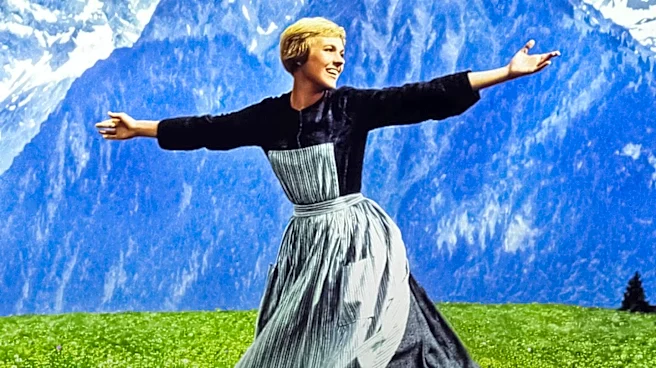





"The Sound of Music," in both its film and stage musical forms, presents a story that is deeply inspired by the real-life history of the von Trapp family, yet it takes significant liberties with historical accuracy. The musical was not directly based on Maria von Trapp's 1949 memoirs, but rather on the 1956 West German film "The Trapp Family." This earlier film served as the primary inspiration for the Broadway musical, with its plot closely mirroring
many scenes. Understanding these distinctions helps to appreciate how the narrative was crafted to create a compelling and beloved story, even if it diverged from the actual events.
The West German screenwriters introduced several significant changes to the family's story, which were subsequently retained in the musical. For instance, in reality, Maria was initially hired to tutor only one child, Maria Franziska, who had scarlet fever and needed lessons at home. However, the 1956 film, and consequently "The Sound of Music," depicted her as the governess to all seven children. This alteration immediately set a different dynamic for Maria's role within the family and her relationship with Captain von Trapp.
Character Portrayals and Real-Life Counterparts
Many of the characters in "The Sound of Music" are fictionalized versions of their real-life counterparts. Captain Georg von Trapp, for example, is portrayed in the film as a humorless, emotionally distant father. In stark contrast, his third child, Maria Franziska von Trapp (named "Louisa" in the film), described her father as a doting parent who crafted handmade gifts for his children in his woodshop and often led family musicales on his violin. The film's depiction of Georg as stern and militaristic served a dramatic purpose, highlighting Maria's role in bringing music and warmth back into the household.
Maria Augusta Kutschera, the real Maria, was indeed a novice at Nonnberg Abbey and was hired by the von Trapp family. However, her marriage to Georg was more for practical reasons than immediate love. Maria wrote in her memoir, "I really and truly was not in love. I liked him but didn't love him. However, I loved the children, so in a way I really married the children. I learned to love him more than I have ever loved before or after." They married in 1927, not in 1938 as depicted in the film, and had been married for over a decade with two of their three children together by the time of the Anschluss. The film's romanticized portrayal of their courtship and marriage served to enhance the fairy tale aspect of the story.
The Von Trapp Family's Escape and Financial Realities
The dramatic escape of the von Trapp family over the Alps to Switzerland in the film is another significant departure from history. In reality, such a journey would have been impossible, as Salzburg is over two hundred miles from Switzerland. The family's villa was only a few kilometers from the Austria–Germany border, and the final scene of the film shows them hiking on the Obersalzberg near the German town of Berchtesgaden, within sight of Adolf Hitler's Eagle's Nest retreat. The actual escape was far less cinematic: the family simply walked to the local train station and boarded a train to Italy. They were entitled to Italian citizenship because Georg had been born in Zadar, Dalmatia, Austria-Hungary, which became part of Italy after World War I. From Italy, they traveled to Switzerland, France, and London, eventually emigrating to the United States on their Italian passports.
The film also exaggerated the family's standard of living. While the real family lived in a large and comfortable villa in Aigen, a district of Salzburg, it was not as grand as the mansion depicted in the film, nor was it their ancestral home. The von Trapp family actually lost most of its wealth during the worldwide depression of the early 1930s when the Austrian national bank collapsed. To survive, they dismissed their servants and began taking in boarders. They also started singing onstage to earn money, a fact that caused the proud Georg considerable embarrassment. This financial hardship and the necessity of performing for income are largely glossed over in the film, which focuses more on their musical talent as a means of expression and eventual escape.
Artistic License and Reception
Robert Wise, the director of the 1965 film, met with Maria von Trapp and made it clear that he was not making a "documentary or realistic movie" about her family. He intended to make the film with "complete dramatic freedom" to produce a "fine and moving film." This approach allowed the filmmakers to use artistic license to convey the essence and meaning of their story, even if it meant altering historical details. The film incorporated many "fairy tale" tropes, including idyllic imagery, European villas, and a cross-class, Cinderella-like romance between Maria and Captain von Trapp.
The film's reception in Austria and West Germany was notably different from its global success. In these countries, it had to contend with the much-loved "Die Trapp-Familie" (1956) and its sequel, which were widely popular and considered the authoritative von Trapp story. Austrians took exception to the liberties taken with costumes and the replacement of traditional Austrian folk songs with Broadway show tunes. The film's Nazi theme was also unpopular in West Germany, leading to an unauthorized cutting of the entire third act in Munich, which was later reversed. Despite these regional criticisms, the film's blend of historical inspiration and fictionalized narrative created a timeless classic that continues to resonate with audiences worldwide.