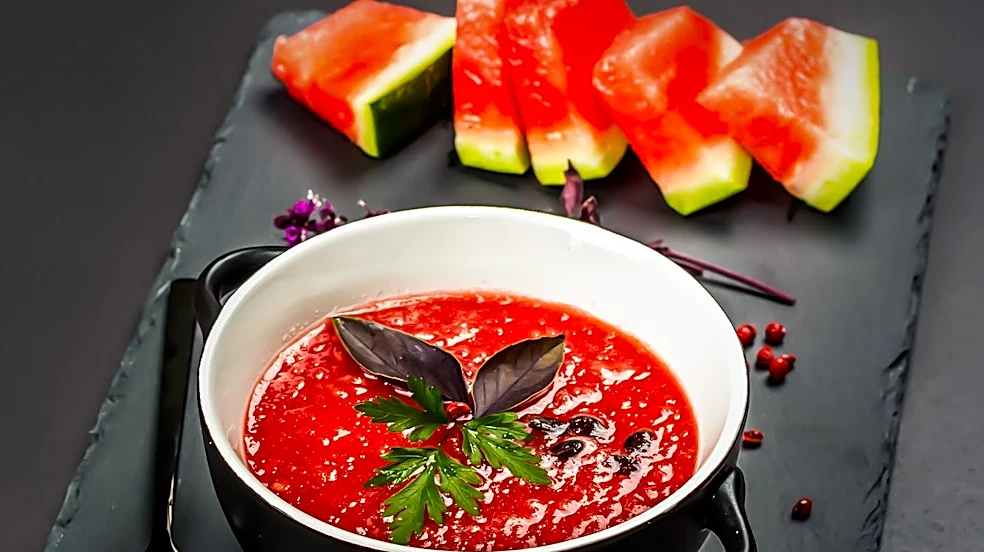










Gazpacho, a cold soup and drink made from raw, blended vegetables, is a culinary staple originating in the southern regions of the Iberian Peninsula, specifically Andalusia in Spain and Alentejo in Portugal. Widely enjoyed, particularly during the summer months, its refreshing qualities have made it a popular dish. While the standard usage of the term "gazpacho" typically refers to this well-known soup, the history and regional culinary landscape
reveal a much broader and more diverse family of dishes sharing the name or close kinship.
The origins of gazpacho are steeped in various theories, reflecting its long presence in Iberian cuisine. One prominent theory suggests that an early form of gazpacho, consisting of bread, olive oil, water, vinegar, peas, and garlic, was introduced to Spain by the Romans. The very word "gazpacho" itself may trace back to the Latin adjective *caccabaceus*, derived from *caccabus*, meaning "cauldron." This Latin term was applied in ancient Rome to a type of bread that bore a strong resemblance to the *torta de gazpacho*, a bread still used in some gazpacho variants today.
From Roman Roots to Southern Spanish Staple
Once established in Spain, this early bread-based soup became an integral part of southern cuisine, particularly in the Castilian kingdoms of Córdoba, Seville, and Granada. These early versions were often similar to *ajoblanco*, utilizing stale bread, garlic, olive oil, salt, and vinegar. The evolution of gazpacho continued over centuries, adapting to available ingredients and regional preferences. A significant turning point occurred during the 19th century with the introduction of tomatoes, which led to the creation of the red gazpacho that is now internationally recognized and commonly consumed.
This tomato-infused version quickly gained popularity and spread globally, becoming the most familiar form of the dish. However, it's important to note that while red gazpacho is dominant, many modern variations exist. These contemporary interpretations can incorporate a wide array of ingredients beyond the traditional, such as avocados, cucumbers, parsley, strawberries, watermelon, grapes, meat stock, and even seafood, sometimes replacing tomatoes and bread entirely. This demonstrates the dish's adaptability and its capacity for culinary innovation while retaining its core identity as a refreshing, often cold, vegetable-based preparation.
A Family of Related Dishes and Regional Distinctions
Beyond the standard tomato-based gazpacho, the Iberian Peninsula boasts a rich array of related dishes, often considered variants, that highlight the diversity of this culinary tradition. These include *ajoblanco*, a white gazpacho made with almonds and garlic; *salmorejo*, a thicker, creamier version from Córdoba; *pipirrana*; and *porra antequerana*, which is closer to a bread soup. Another notable relative is *cojondongo*, further illustrating the regional creativity within this category of cold soups.
It's crucial to distinguish between these variations and other dishes that might share a similar name but have vastly different characteristics. For instance, *gazpacho manchego* from the region of Castile-La Mancha is a distinct dish. Unlike the cold, blended vegetable soup, *gazpacho manchego* is a type of stew featuring chicken, rabbit, and *tortas de gazpachos*. This highlights that while the name "gazpacho" might be shared, the culinary traditions behind them can be quite separate. Similarly, in Andalusia and Extremadura, *sopa de tomate* (literally "tomato soup") refers to a traditional hot soup with stale bread, bell peppers, onion, garlic, and often poached eggs, cooked and eaten hot, and distinct from the cold, raw vegetable gazpacho.